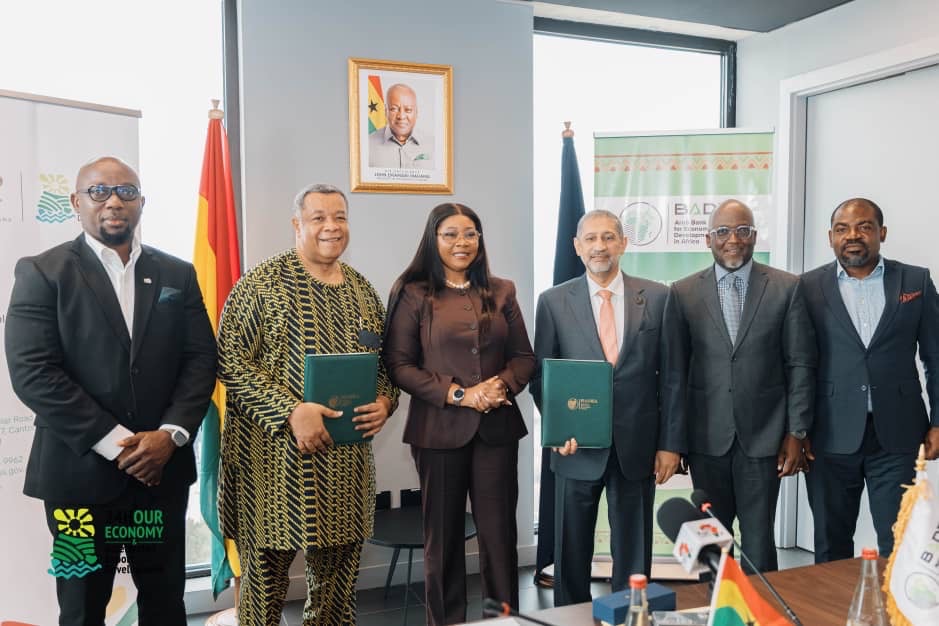
Hon Goosie Tanoh Presidential Advisor of the 24 hour economy , Miss Matilda Asante,deputy governor of the Bank of Ghana, H.E Abdullah President BADEA
The Government of Ghana took a significant step toward realizing its flagship economic policy, signing a formal agreement with the Arab Bank for Economic Development in Africa (BADEA) to finance and support its 24-Hour Economy & Accelerated Export Development Programme (24H+).
The Memorandum of Understanding (MoU), signed at a ceremony at the Bank of Ghana in Accra, establishes a framework for collaboration aimed at mobilizing investment to modernize key sectors of the Ghanaian economy. The partnership is designed to enhance competitiveness, expand exports, and create jobs, with a focus on supporting small businesses, agriculture, and critical infrastructure.
In his remarks, Presidential Advisor on the 24H+ Programme, Mr. Goosie Tanoh, emphasized the direct impact the partnership is expected to have on the ground. “This MoU opens new doors for the Ghanaian entrepreneur who wants to expand production, the farmer looking to grow her shop, and the young innovator with an idea that can change our country,” he said.
The President of BADEA, H.E. Abdullah Almusaibeeh, who led the bank’s delegation, commended Ghana’s vision for inclusive growth. “With this memorandum of understanding, we are laying the foundation for a new and promising chapter in Arab-African cooperation,” he stated.
He outlined a multi-faceted support package from BADEA that will include:
* Technical assistance to strengthen Ghana’s capacity for programme implementation.
* A trade finance facility to support the country’s food security strategy and promote balanced trade.
* Affordable financing for small and medium-sized enterprises (SMEs) to enable expansion and job creation.
* Support for Public-Private Partnerships (PPPs) to accelerate investment in the infrastructure necessary for a round-the-clock economy.
The 24-Hour Economy policy is a central plank of the administration’s economic transformation agenda. It aims to incentivize and support businesses to operate across multiple shifts, thereby maximizing the use of national infrastructure, creating more employment opportunities, and boosting overall economic output.
The Second Deputy Governor of the Bank of Ghana, Mrs. Matilda Asante-Asiedu, welcomed the partnership and underscored the central bank’s role in ensuring its success. “This signing is more than symbolic; it demonstrates our shared commitment to Africa’s structural transformation,” she said. “The Bank of Ghana will continue to ensure a stable financial environment that supports this initiative.”
The agreement with BADEA, a financial institution owned by Arab member states of the Organization of Arab Petroleum Exporting Countries (OAPEC), represents a critical move by Ghana to secure strategic international partnerships and funding to accelerate its domestic economic ambitions.
About BADEA:
The Arab Bank for Economic Development in Africa (BADEA) is a financial institution owned by Arab member states of the Organization of Arab Petroleum Exporting Countries (OAPEC). Its mandate is to contribute to Africa’s economic development and strengthen economic cooperation between Arab and African nations.
Barely eight months into the National Democratic Congress (NDC) administration, subtle manoeuvres and whispered campaigns from potential flagbearer aspirants are threatening to shift focus from the government’s “Resetting the Economy” agenda, political analysts have observed.
This early jostling for position, occurring even as President John Dramani Mahama settles into the Jubilee House, has sparked a debate on timing, party unity, and the strategic preparation needed to secure electoral victory in 2028.
Names such as National Chairman Johnson Asiedu Nketia, Chief of Staff Julius Debrah, Agriculture Minister Eric Opoku, and Education Minister Haruna Iddrisu are being whispered in political circles as those already “lacing their boots” for the succession race.
This development stands in stark contrast to the main opposition New Patriotic Party (NPP), which is methodically preparing to elect its presidential candidate this January. The frontrunners in that contest are expected to be former Vice President Dr. Mahamudu Bawumia, Former Assin Central MP Kennedy Agyapong, and former Agriculture Minister Bryan Acheampong.
A Premature Race?
Speaking to “Tv Democrat, Politics Today”, Senior Political Analyst , Lord Fiifi Quayle, cautioned the NDC against early in-fighting.
“The greatest asset for any NDC candidate in 2028 will be the performance of the Mahama government,” Lord Quayle stated. “Any subliminal campaigning now is a strategic error. It creates factions, distracts ministers from their core mandate of delivering on campaign promises, and presents an image of disunity and ambition over governance to the Ghanaian electorate.”
He added that while the NPP’s early contest is a necessity of being in opposition, the ruling party has the luxury of time and should prioritise governance.
The NPP’s Calculated Early Move
Across the aisle, the NPP is hoping its early primary will allow it to unite quickly behind a flagbearer and present a strong, focused opposition for the next three years.
Each potential candidate offers a different appeal.
Dr. Bawumia carries high name recognition but also the baggage of the previous government’s economic record.
Kennedy Agyapong commands a massive grassroots populist base but remains a polarising figure.
Bryan Acheampong is seen as a strong, decisive dark horse with significant influence within the party.
A source within the NPP, who spoke on condition of anonymity, told this network: “Our message in 2028 will be simple: a referendum on the NDC’s performance. If they fail Ghanaians, as we expect they will, our candidate, whether Bawumia, Ken, or Bryan, will be the natural alternative. Our early contest is to ensure we are ready and united.”
A Test of Discipline for the NDC
For the NDC, the challenge will be to keep its ambitious figures focused on their current assignments. The government’s ability to stabilize the economy, alleviate the cost of living, and create jobs will be the ultimate determinant of whether the party can retain power, regardless of who leads it.
A party communicator, Kwame Gyamfi, defended the right of individuals to have ambitions but agreed on the need for caution. “It is healthy for democracy to have many capable leaders. However, the party’s discipline must hold. The focus for today, tomorrow, and the next three years must be on supporting H.E. President Mahama to deliver for Ghana. The time for internal competition will come, but it is not now.
As the political temperature begins to rise years ahead of schedule, Ghanaians will be watching to see which party manages its internal dynamics better, for it is often discipline and unity that win elections as much as policies and promises.
I want to share something personal with you today. The other evening, tired after a long day, I was watching a cartoon on Netflix. There was a scene showing a mother rat teaching her young pups what to do when faced with a predator. Her lesson? To flip over, go limp, and play dead.
I am convinced to them, it is a sophisticated survival technique. But I sat there, and something about it just didn’t sit right with my spirit. It struck me that this is exactly the kind of lesson we have been teaching ourselves for too long. When faced with a challenge, be it economic hardship, a lack of opportunity, or simply the fear of failure, our first instinct has been to play dead. To wait for the threat to pass. To hope someone else will come along and explain why we couldn’t succeed.
That is where the phrase hit me: Dead people don’t explain things.
A nation that plays dead cannot explain to its children why it didn’t build the schools, the roads, or the industries. A generation that plays dead cannot explain to the next why they let their dreams fade. We cannot, from a place of inaction, ever justify inaction. The explanation dies with the opportunity.
This is why my every waking moment is focused on one thing: changing that instinct from playing dead to standing up and building. Believing in Ghana again is about giving every entrepreneur, every young graduate, every farmer the confidence that if they stand up and face the challenge, the system will stand with them, not against them. It’s about creating the right soil for your seeds to grow.
This isn’t just theory. You see it happening. The road expansions aren’t just tarmac; they are veins carrying the lifeblood of commerce. The new high-rises aren’t just steel and glass; they are monuments to our new ambition. The technology in our fields and clinics isn’t just gadgetry; it’s a promise of a smarter, healthier, more prosperous life for all.
This is the Ghana we are building together. Not by pretending our challenges don’t exist, but by facing them head-on with creativity, resilience, and a stubborn belief that we can win.
So to our incredible youth, I say this: Your greatest opportunity is this very moment. Each day is your chance to build something that will make your brother proud, your neighbour secure, and your country strong. Don’t play dead. Don’t wait for an explanation. Be the explanation.
Let’s dare for the impossible. Let’s challenge our own status quo. Let’s put on that resilient spirit that is our true heritage and build a Ghana that future generations will not only deserve but will also look back on and say, “That was the generation that chose to build.”
The Black Star is rising because we are choosing to rise with it.
Ghana’s economic recovery has gained significant momentum in 2025, offering valuable insights for preventing economic failure in developing countries. With fresh data from the first half of 2025, Ghana’s experience provides an updated roadmap for economic stabilization and sustainable growth across Africa.
Ghana’s Economic Performance in 2025: Strong Recovery Momentum
Ghana’s economy has demonstrated remarkable resilience in 2025, with GDP growth reaching 5.3% year-on-year in the first quarter, significantly outperforming the 4.9% recorded in Q1 2024 Business Insider Africa. This performance has exceeded initial forecasts that estimated GDP growth between 4.5% and 4.8% for the year, with analysts now suggesting full-year 2025 growth could surpass the upper-band forecast of 4.8%.
The most encouraging aspect of Ghana’s 2025 performance has been the strength of the non-oil sector, which recorded a robust 6.8% year-on-year growth in Q1 2025, despite a contraction in the oil and gas sector during the same period. This reflects strong underlying momentum in the real economy and has significantly boosted optimism about Ghana’s growth outlook for 2025, despite downside risks from fiscal tightening Business Insider Africa.
However, significant gains were made as of May 2025. Inflation was down at 18.4% year-on-year as of April 2025, with monthly inflation at 0.8% Bank of Ghana. The monetary policy rate remains high at 28.00%, with average lending rates at 31.25%, reflecting the Bank of Ghana’s continued efforts to combat inflation and maintain macroeconomic stability.
Luckily the exchange rate began to appreciate 24.1% year-to-date against the US dollar as of May 2025, reaching GHS 11.85 per dollar Bank of Ghana. With a gross international reserves standing at USD 6.6 billion as of April 2025, providing 3 months of import cover.
Major Milestones in Ghana’s Recovery Program
IMF Program Success and Fiscal Consolidation
Ghana achieved a crucial milestone in July 2025 when the IMF Executive Board completed the fourth review of its 36-month Extended Credit Facility arrangement, allowing for an immediate disbursement of approximately $367 million Reuters. This brings Ghana’s total IMF disbursements to significant levels, demonstrating the country’s commitment to its reform program despite challenges.
The government has passed a 2025 budget consistent with the IMF program’s objectives and enacted an enhanced fiscal responsibility framework, including new rules to tighten expenditure commitments IMF. The fiscal deficit for 2025 is projected at 3.1% of GDP, with a primary surplus target of 1.5%, representing a significant improvement from previous years World Bank.
Debt Restructuring Progress
A landmark achievement in 2025 was Ghana’s parliament approval in June of a $2.8 billion debt restructuring deal with 25 creditor nations, including China, France, the United States, Germany, and the United Kingdom Reuters. This deal provides debt service relief of $2.8 billion during the IMF-supported program period (2023-2026), with debt service payments due between December 2022 and December 2026 being rescheduled and repaid from 2039 to 2043.
Under the restructuring terms, interest rates are set at 1% to 3% to capitalize rescheduled amounts, depending on the original contractual rate, offering Ghana’s treasury significant savings below market levels. As of March 2025, total public debt stood at GHC 683.1 billion (USD 53.1 billion), representing 58.1% of GDP Bank of Ghana.
Fitch Ratings has expressed optimism about Ghana’s debt restructuring process, expecting the country to fully complete external debt restructuring by the end of 2025 CNBC Africa. The rating agency upgraded Ghana to B- with a stable outlook, forecasting real GDP growth of around 4% and expecting inflation to decrease to an average of 15% in 2025.
Africa’s Economic Outlook 2025: Context for Ghana’s Recovery
Ghana’s recovery is occurring within a broader context of African economic resilience. According to the African Development Bank’s 2025 African Economic Outlook, Africa’s economy is projected to grow from 3.3% in 2024 to 3.9% in 2025, reaching 4.0% in 2026, outpacing global averages African Development Bank.
The continent’s growth is being driven by effective domestic reforms and improved macroeconomic management, with 21 African countries expected to achieve growth exceeding 5% in 2025. Four countries—Ethiopia, Niger, Rwanda, and Senegal—are potentially reaching the critical 7% threshold required for poverty reduction and inclusive growth.
Regional performance varies significantly across Africa in 2025. East Africa leads with projected 5.9% growth in 2025-2026, driven by resilience in Ethiopia, Rwanda, and Tanzania. West Africa maintains solid 4.3% growth, while North Africa is expected to register 3.6% growth. Central Africa’s growth is projected to slow to 3.2%, and Southern Africa will grow at only 2.2%, with South Africa expected to achieve only 0.8% growth African Development Bank.
However, significant challenges persist across the continent. Fifteen countries are experiencing double-digit inflation, while interest payments now consume 27.5% of government revenue across Africa, up from 19% in 2019. The continent also faces massive capital outflows, with approximately $587 billion in outflows including $90 billion in illicit flows, $275 billion in profit shifting, and $148 billion in corruption losses.
Sectoral Performance and Diversification Progress
Strong Non-Oil Sector Performance
Ghana’s 2025 economic performance has been particularly impressive in the non-oil sector, which has demonstrated the importance of economic diversification. Key sectors contributing to Q1 2025 growth include:
Fishing: 16.6% growth
Information and Communication Technology (ICT): 13.1% growth
The agriculture sector posted a remarkable 6.6% growth in Q1 2025, driven mainly by a 6.7% increase in the high-weight crops sub-sector. This performance has been a contributing factor to the consistent decline in annual food inflation since February 2025, though the sector has yet to fully reflect the government’s ongoing investments in agriculture aimed at supporting lower food inflation.
Manufacturing and Services Resilience
The manufacturing sector’s 6.6% growth in Q1 2025 demonstrates the potential for industrial development, while the strong performance in ICT (13.1%) and finance and insurance (9.3%) sectors reflects Ghana’s progress in developing higher-value service industries. These sectors are crucial for long-term economic diversification and job creation.
Lessons from Africa’s Top Performers in 2025
Rwanda’s Continued Excellence
Rwanda continues to demonstrate exceptional economic performance, maintaining its position as one of Africa’s top-performing economies. The country is among the four expected to exceed 7% growth in 2025, building on its track record of averaging over 7% GDP growth annually over the past two decades African Development Bank.
Rwanda’s success continues to rest on strong political leadership, consistent policy implementation, and strategic investments in human capital and infrastructure. The country’s approach to structural transformation through its National Strategy for Transformation (NST-2) provides a model for other African countries seeking to achieve middle-income status.
Ethiopia’s Diversification Drive
Ethiopia’s inclusion among the top four performers expected to exceed 7% growth in 2025 reflects the country’s commitment to economic diversification and manufacturing development. The country’s homegrown economic reform program prioritizes manufacturing sector growth as a key pillar of economic transformation.
Ethiopia’s focus on expanding its manufacturing base while maintaining agricultural productivity demonstrates the potential for successful structural transformation in Africa. The country’s experience illustrates how strategic industrial policy can support diversification away from traditional agricultural dependence.
Senegal’s Oil and Gas Success
Senegal’s emergence as a top performer in 2025 is largely driven by new oil and gas production coming onstream. The country’s ability to manage its newfound energy resources while maintaining economic stability provides valuable lessons for other African countries discovering natural resources.
Senegal’s approach emphasizes the importance of proper institutional frameworks and transparent governance in managing natural resource wealth. The country’s experience demonstrates how new resource discoveries can be leveraged to support broader economic development when properly managed.
Updated Policy Recommendations for Sustainable Growth
Fiscal Consolidation with Growth-Friendly Measures
Ghana’s 2025 experience demonstrates the importance of balancing fiscal consolidation with growth-supportive policies. The country’s ability to achieve a primary surplus target of 1.5% of GDP while maintaining positive economic growth shows that fiscal discipline need not come at the expense of economic expansion when properly implemented.
Key elements of Ghana’s approach include:
Monetary Policy Coordination
Enhanced Fiscal Responsibility Framework: The enactment of strengthened fiscal rules and expenditure controls provides a foundation for sustainable public finances while maintaining investor confidence.
Revenue Optimization: Focus on improving tax collection and broadening the tax base rather than relying solely on expenditure cuts, which can undermine growth prospects.
Strategic Public Investment: Continued investment in infrastructure and human capital that supports long-term productivity growth while maintaining fiscal discipline.
Ghana’s monetary policy approach in 2025 demonstrates the importance of coordinated macroeconomic management. The Bank of Ghana’s maintenance of a high monetary policy rate (29.00%) while supporting economic recovery shows the delicate balance required between price stability and growth objectives.
The elimination of monetary financing of the budget has been crucial in restoring credibility and supporting disinflation efforts. Other African countries can learn from Ghana’s experience in rebuilding central bank independence and credibility after periods of fiscal dominance.
Exchange Rate Management
Ghana’s experience with exchange rate pressures in 2025 highlights the ongoing challenges facing African economies. The 5.3% year-to-date depreciation of the cedi against the US dollar as of March 31,2025 though steady demonstrates the vulnerability of African currencies to external shocks and capital flow reversals.
Flexible Exchange Rate Systems: Allowing currencies to adjust to external pressures while avoiding excessive volatility
Supporting Policies: Implementing fiscal and monetary policies that support currency stability
Debt Management and Restructuring
Ghana’s 2025 debt restructuring experience provides a template for other African countries facing debt sustainability challenges. The successful completion of the official creditor restructuring demonstrates the importance of:
Comprehensive Approach: Addressing both domestic and external debt in a coordinated manner
Multilateral Support: Working with international financial institutions to provide credible reform programs
Stakeholder Engagement: Maintaining dialogue with creditors and civil society throughout the process
Legislative Approval: Ensuring democratic oversight and approval of restructuring agreements
Challenges and Risks for 2025-2026
Inflation Persistence
Despite progress in many areas, Ghana’s inflation rate of 18.4% as of April 2025 remains well above target levels. The persistence of high inflation poses risks to:
Real income growth and poverty reduction
Investment decisions and business planning
Exchange rate stability
Monetary policy effectiveness
Addressing inflation requires continued tight monetary policy coordination with fiscal consolidation and structural reforms to improve supply-side constraints.
External Vulnerabilities
Ghana’s continued dependence on commodity exports and vulnerability to external shocks remain significant challenges. The country’s current account performance, while improved, remains susceptible to:
Commodity price volatility
Global economic conditions
Capital flow reversals
Exchange rate pressures
Implementation Capacity
The success of Ghana’s reform program depends critically on implementation capacity. Key challenges include:
Maintaining reform momentum across political cycles
Building technical capacity for policy implementation
Ensuring coordination across government agencies
Managing social and political pressures from adjustment costs
Regional Integration and Trade Opportunities
AfCFTA Implementation
The African Continental Free Trade Agreement (AfCFTA) presents significant opportunities for Ghana and other African countries to expand their economic base through regional integration. Ghana’s recovery in 2025 positions the country to take advantage of expanded regional trade opportunities.
Key benefits from AfCFTA implementation include:
Market Access: Expanded access to regional markets for Ghanaian goods and services
Industrial Development: Opportunities for value-added manufacturing for regional markets
Investment Flows: Increased intra-African investment and technology transfer
Economies of Scale: Ability to achieve scale economies in smaller domestic markets
Infrastructure Development
Ghana’s infrastructure investments, particularly in transportation and energy, are crucial for supporting both domestic growth and regional integration. The country’s experience demonstrates the importance of:
Strategic Infrastructure Investment: Focusing on projects that enhance productivity and competitiveness
Regional Connectivity: Developing infrastructure that supports regional trade and integration
Private Sector Participation: Leveraging private sector resources and expertise for infrastructure development
Sustainable Financing: Ensuring infrastructure investments are financially sustainable and contribute to long-term growth
Technology and Innovation for Economic Transformation
Digital Economy Development
Ghana’s strong ICT sector performance (13.1% growth in Q1 2025) highlights the potential for digital economy development in Africa. The sector’s growth demonstrates the importance of:
Digital Infrastructure: Investing in broadband and mobile infrastructure
Digital Skills: Developing human capital for the digital economy
Regulatory Framework: Creating supportive regulatory environments for digital innovation
Financial Inclusion: Leveraging digital technologies for financial inclusion and economic participation
Innovation Ecosystems
Developing innovation ecosystems is crucial for long-term economic transformation. Ghana’s experience suggests the importance of:
Education and Research: Investing in higher education and research capabilities
Public-Private Partnerships: Fostering collaboration between government, universities, and private sector
Entrepreneurship Support: Providing support for startup development and entrepreneurship
Technology Transfer: Facilitating technology transfer and knowledge sharing
Environmental Sustainability and Climate Resilience
Green Growth Strategies
Ghana’s recovery program increasingly incorporates environmental sustainability considerations. The country’s experience demonstrates the importance of:
Climate-Resilient Infrastructure: Investing in infrastructure that can withstand climate shocks
Renewable Energy: Diversifying energy sources to reduce dependence on fossil fuels
Environmental Regulation: Implementing and enforcing environmental standards
Climate Finance
Access to climate finance is crucial for supporting sustainable development in Africa. Ghana’s experience highlights the need for:
Climate Policy Framework: Developing comprehensive climate policies and strategies
International Cooperation: Engaging with international climate finance mechanisms
Private Sector Engagement: Leveraging private sector investment in climate solutions
Capacity Building: Developing technical capacity for climate finance and project management
Conclusion: A Roadmap for African Economic Success
Ghana’s economic recovery in 2025 provides a compelling case study for avoiding economic failure and achieving sustainable growth in Africa. The country’s experience demonstrates that with appropriate policies, international support, and sustained commitment to reform, even countries facing severe economic crises can achieve remarkable turnarounds.
International Partnership: Collaboration with international financial institutions and development partners is crucial for credibility and financing
Debt Sustainability: Proactive debt management and restructuring are essential for maintaining fiscal space
Economic Diversification: Reducing dependence on commodities through diversification is crucial for long-term resilience
Institutional Strength: Building strong institutions and governance systems is fundamental for sustainable development
As Ghana continues its recovery journey, the country’s experience offers hope and practical guidance for other African nations facing similar challenges. The continent’s projected growth of 3.9% in 2025, with 21 countries expected to achieve growth exceeding 5%, demonstrates the potential for widespread economic transformation across Africa.
The success of Ghana’s program, combined with strong performances in countries like Rwanda, Ethiopia, and Senegal, shows that economic failure is not inevitable in Africa. With appropriate policies, strong institutions, and sustained commitment to reform, African countries can build resilient economies capable of delivering sustained improvements in living standards for their populations.
The path forward requires continued focus on fiscal responsibility, monetary stability, structural transformation, and regional integration. Most importantly, it requires sustained political commitment to reform and the development of institutional capacity to implement and maintain sound economic policies over time.
Ghana’s journey from economic crisis to recovery in 2025 serves as both an inspiration and a practical guide for African countries seeking to avoid economic failure and build prosperous, resilient economies for their people. The lessons learned from this experience will be invaluable for shaping Africa’s economic future in the years ahead.
Amidst the shared grief and murmured condolences, I found myself standing next to Ransford, an old school mate. Our conversation, drifting from the solemnity of the moment to the frustrations of daily life, inevitably turned towards the state of things: the government, the legendary inefficiencies, the beleaguered Ghanaian task force. “Sometimes,” Ransford sighed, “it feels like the system is built to fail us. When the very people meant to serve become the barrier… what then?” It was then, amidst the raw vulnerability of loss and shared exasperation, that the phrase landed with the weight of a tombstone: **”Technology steps in when man fails man.”** That mid morning conversation with Ransford became the stark motivation for this reflection.
Ransford’s lament wasn’t abstract. He spoke of containers languishing at Tema Port for weeks, hostage to opaque procedures and whispered “facilitation fees.” He spoke of the farmer watching his perishable harvest spoil while waiting for rickety cars to transport them to market places. He spoke of the ordinary Ghanaian trying to make ends meet yet Human gatekeepers seemed more obstacle than aide. These are not system glitches; they are profound human failures – failures of empathy, integrity, and duty.
And it is precisely into these chasms of human frailty and systemic breakdown that Ghanaian technology is increasingly, and often heroically, stumbling.
1. Bypassing the Bottleneck (Ports & Logistics): Where human intermediaries created costly delays and opportunities for graft, digital platforms are emerging. Online port clearance systems, real-time cargo tracking apps, and electronic payment gateways are slowly but surely reducing the physical touchpoints where “man fails man.” Technology doesn’t eliminate corruption instantly, but it shines a harsh light on deviations, creates auditable trails, and empowers the honest importer or transporter. It steps in where human gatekeeping became a failure of service.
2. Connecting the Disconnected (Agriculture & Markets): Remember the farmer Ransford mentioned? Mobile technology is his lifeline. Apps connecting farmers directly to buyers, mobile payment systems eliminating the risky cash-carry to distant markets, SMS-based weather alerts and agronomic advice – these tools bypass the often unreliable or exploitative middlemen. When traditional market structures failed smallholders, technology offers an alternative channel, ensuring fairer prices and reducing spoilage. It steps in where market access, hindered by human inefficiency or indifference, failed the producer.
3. Demanding Accountability (Civic Engagement): When traditional avenues for holding officials or task forces accountable feel inaccessible or ignored, social media and civic tech platforms become the megaphone. Citizens document service failures, report corruption anonymously via apps, and mobilize communities online to demand action. Technology amplifies the voices that human systems might deliberately silence or conveniently overlook. It steps in where transparency and accountability, core human responsibilities of governance, failed the citizen.
The Ghanaian Paradox: Hope Tempered by Caution
This technological intervention, as Ransford and I acknowledged, is a double-faced KENTE cloth:
* The Efficiency Mirage: Does a sleek app for business registration truly fix the underlying culture of bureaucratic inertia or rent-seeking it tries to circumvent? Technology can be a workaround, masking the deeper rot rather than curing it.
* The Exclusion Risk: Not every farmer has a smartphone; not every trader is digitally literate. When technology steps in, who might it inadvertently leave behind, amplifying existing inequalities? The human failure of exclusion must not be replicated in the digital solution.
* The Accountability Vacuum (Redux): When an algorithm flags a customs irregularity instead of a human officer, who bears ultimate responsibility? When a civic reporting app is ignored by the authorities, is the failure technological or profoundly human? The buck must not disappear into the server rack.
Beyond the Workaround: A Call for Human Reformation
My conversation with Ransford at the funeral wasn’t just about identifying problems; it was a shared yearning for a better Ghana. Technology’s role in stepping where humans fail is not a permanent victory lap for silicon. It is, as we agreed, a stark diagnostic tool and a temporary crutch.
* The Diagnostic: Every fintech app succeeding points to a banking sector that failed the informal trader. Every successful e-government portal highlights the inefficiency of the manual system it replaced. Every civic tech platform gaining traction underscores a failure in traditional accountability mechanisms. Technology holds up an unforgiving mirror.
* The Crutch: It keeps things moving DESPITE the failures. It allows the farmer to sell, the importer to clear goods, the citizen to report – even when the human system stumbles. It prevents total collapse.
The Uncomfortable Question for Ghana:
As Ransford and I parted ways at the funeral, the question lingered, heavier than the humid air: Are we using technology merely to paper over the cracks of our human and systemic failures, or is it catalyzing the deep, necessary reform?
Technology is catching Ghana’s fall in countless ways, big and small. It powers the mobile money transaction when the bank is too far or too slow. It delivers the lifesaving health information when the clinic is understaffed. It tracks the goods when the human chain is broken. But its true award-worthy potential lies not just in the efficiency it brings, but in the uncomfortable truth it forces us to confront about ourselves.
The circuits are holding up parts of our broken system. The challenge Ransford and I grappled with remains: Will we use this technological intervention as a wake-up call to rebuild the human foundations – fostering INTEGRITY, EFFICIENCY, and GENUINE SERVICE – so that technology becomes a tool for progress, not just a reluctant SAVIOUR from our own FAILINGS? The answer to that will define Ghana’s future far more than any app.
Being: Rooted in abstraction and universality. It sees the world as a collection of problems to be solved by standardized, efficient systems. Value is measured by speed, scale, connectivity, and control.
Knowing: Relies on externalized, digitized knowledge. Wisdom resides in databases, algorithms, and global networks. Understanding is fragmented, specialized, and dependent on complex, invisible infrastructures (the “black box”).
Ethics: Prioritizes individual empowerment, consumption, novelty, and often, a subtle alienation from place and community. Resilience is sought through more technology, more complexity, more control.
Vulnerability: Its strength is also its weakness. It creates profound dependencies and systemic fragility. A single point of failure (power, data, a supply chain link) can collapse vast swathes of perceived reality. It operates on borrowed time and borrowed stability.
The Mode of Robustness (Culturally Embedded Tradition):
Being: Rooted in embodiment and particularity. It understands the world through lived experience within a specific place and within a web of relationships (human, natural, ancestral). Value is measured by endurance, reciprocity, harmony, and meaning derived from context.
Knowing: Relies on embodied, tacit, narrative knowledge. Wisdom is passed down through stories, rituals, craftsmanship, and direct interaction with the local environment. Understanding is holistic, contextual, and resilient to external disruption because it resides in people and practices.
Ethics: Prioritizes community well-being, respect for limits (natural and social), continuity, and a deep sense of belonging. Resilience is inherent in diversity, redundancy, local adaptation, and mutual aid.
Vulnerability: Its weakness is often inertia and inadaptability to truly novel, large-scale challenges. It can ossify, preserving harmful practices alongside valuable ones. Its strength lies in weathering known storms, not necessarily unforeseen global tsunamis.
The Philosophical Crisis of Transition
The “third world” transition is not merely economic; it’s an existential migration from one mode of existence to another, often forced and incomplete. This creates a profound disorientation:
The Epistemic Abyss: The old, embodied ways of knowing are devalued, deemed “backward.” Yet, the new, abstract knowledge remains inaccessible, unreliable, or contextually meaningless when the infrastructure flickers. People are left knowing neither way fully, existing in a limbo of partial understanding.
The Ontological Shattering: The stable, meaningful world defined by tradition and place is fractured. The new, globalized world offered by technology is enticing but phantasmal – it appears and disappears with the power grid. Identity becomes fluid, contested, and often rootless.
The Erosion of Meaning: Robust cultures derive meaning from deep narratives – connection to land, ancestors, community roles, sacred practices. Fragile modernity often offers meaning through consumption, individual achievement, and fleeting digital connection, which feel hollow when the screen goes dark. The “quality of life” diminishes not necessarily in material terms (which may improve), but in existential depth and resilient purpose.
The Paradox of Complexity: Evolution towards greater societal complexity does create fragility (as per Joseph Tainter). Each new layer (global supply chains, digital finance, hyper-specialization) adds points of potential failure. The wisdom lost is often the wisdom of simplicity, sufficiency, and local repair – the very things that buffer against systemic collapse.
Cultivating Robustness: A Philosophical Imperative
Protecting ourselves isn’t just practical; it’s an ethical act of preserving meaning and authentic being in the face of homogenizing fragility. How?
Embrace Rooted Fluidity: Reject the false choice of stasis or surrender. Be deeply grounded in the wisdom, values, and practices of your place and culture (rootedness), while developing the critical capacity to selectively integrate useful elements of modernity without losing your core (fluidity). Like a deeply rooted tree that bends in the wind.
Value Embodied Knowledge as Sacred: Recognize that the craftsman’s hand, the farmer’s eye, the healer’s intuition, the elder’s story – these are not primitive relics, but repositories of irreplaceable, lived wisdom. Actively engage in and transmit these practices. They are epistemology made flesh.
Practice Critical Frugality: Question the necessity and true cost (existential, not just monetary) of every complex technology. Does it enhance our rooted being, or merely create new dependencies? Choose tools that empower local agency and resilience, not just convenience. Value repairability over novelty.
Cultivate the Communal Self: Understand that robust individuality arises from strong community, not in opposition to it. Invest in face-to-face relationships, mutual obligation, and shared rituals. This web is the ultimate safety net and source of meaning when abstract systems fail. Your robustness is intertwined with the robustness of your neighbors.
Seek Appropriate Scale: Recognize that not all problems require global, complex solutions. Robustness often thrives at the human scale – the village, the neighborhood, the watershed. Foster systems (economic, social, agricultural) that are understandable, manageable, and repairable at this scale. Complexity should serve the local, not dominate it.
Accept Finitude and Impermanence (Wisely): Fragile modernity often promises control and immortality (digital legacies, medical miracles). Robust traditions acknowledge limits – of life, resources, and human understanding. This isn’t resignation, but a source of profound realism and appreciation for the present. Build things to last, but understand that everything ultimately changes. Build for endurance within the cycle, not for illusory permanence against it.
In Essence: The Unbreakable Vessel
Living robustly in an unfolding world is the practice of being authentically human within a specific place and time, amidst the seductive chaos of abstraction. It’s recognizing that the microchip offers light but casts long shadows, while the clay pot, shaped by generations of hands knowing this earth, holds enduring sustenance.
The transition to “first world” status, philosophically understood, is not about replicating fragility, but about building a new synthesis: a society where the power of technology serves to amplify and preserve the depth of rooted being, embodied wisdom, and communal strength – not replace it. True development is measured not just in GDP or bandwidth, but in the unbreakable resilience of meaning, connection, and authentic existence that persists even when the lights go out. This robustness isn’t a rejection of progress; it’s the foundation upon which truly sustainable and meaningful progress can be built. It’s the art of holding the light without shattering the vessel.
Ghana is on the frontlines of the climate crisis. From submerged streets in Accra to vanishing coastlines in the Volta Region, the evidence is undeniable: climate change is ravaging our nation **today**. Under President John Dramani Mahama’s leadership, this existential threat has been elevated to a national priority—demanding immediate, decisive action.
—
1. Urban Deluge: Accra & Kumasi Drowning
The 2025 floods have shattered records across West Africa. While intense rainfall plays a role, the real culprits are clear: **weak land-use enforcement**, suffocating drains choked with plastic waste, and the reckless destruction of vital wetlands. A startling study reveals Ghana suffered **19 major floods between 2000–2020**, costing our economy a crippling **\$780 million (¢9.75 billion)**. Hope emerges from Sekondi-Takoradi, where hybrid solutions (engineered drains + restored wetlands) prove highly effective—yielding **¢168.75 for every cedi invested** by preventing flood damage.
—
2. Coastlines Crumbling: Agavedzi’s Agony
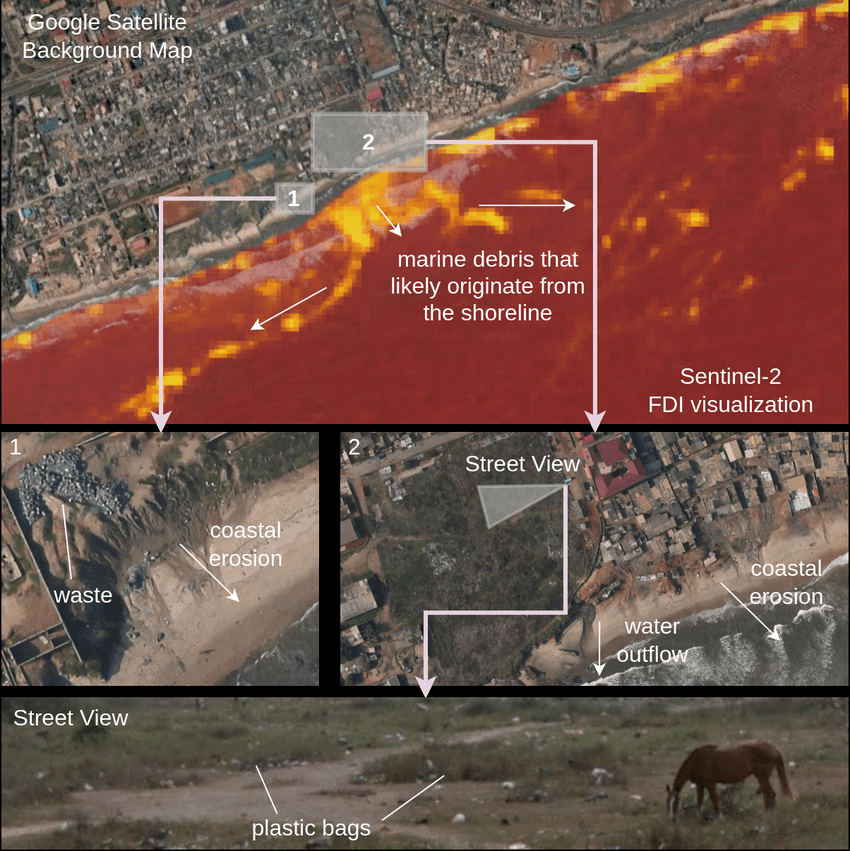
Rising seas are devouring our shores. In Agavedzi, tidal surges recently **smashed 50 homes** and displaced **300 citizens**, erasing livelihoods and ancestral graves. Heartbroken residents describe nights fleeing waves with only their children in their arms. **President Mahama personally visited the site**, calling it “a climate tragedy demanding immediate intervention.” Yet despite his directive and community pleas, protective sea barriers remain delayed, leaving lives in limbo.
—
3. Policy Progress: Mahama’s Climate Mandate in Motion
Fulfilling a core campaign pledge to make climate action “non-negotiable,” President Mahama has championed landmark policies. The **Environmental Protection Act (Act 1124, 2024)**—signed into law this January—empowers the EPA to enforce climate mitigation and adaptation across all sectors. Ghana’s updated National Climate Pledge (NDC), personally endorsed by the President, targets a **15% emissions cut with domestic funds**, plus **30% with international aid** (total: 64 million tonnes CO2 by 2030). At June’s NDC workshop, Mahama stressed: “Our laws must translate to action—communities cannot wait.”
—
4. Nature’s Power: Hybrid Solutions Pay Off
Sekondi-Takoradi’s model aligns with Mahama’s advocacy for “smart, nature-backed resilience.” Blending mangroves with concrete drainage delivers **3–13 times the investment** through avoided floods, captured carbon, and slashed maintenance costs. These systems are Ghana’s smartest defence—and now have presidential backing.
—
5. Funding Flows: Millions for Resilience
Critical finance is arriving, bolstered by the President’s global advocacy:
* **Green Climate Fund:** **\$70 million (¢875 million)** for climate-smart farming in the North, aiding 120 communities.
* **World Bank:** **\$360 million (¢4.5 billion)** Resilient Recovery Program—a direct outcome of Mahama’s push for “climate-proof” economies.
—
6. The Unfinished Battle: What Ghana MUST Do Now
President Mahama’s consistent message—from campaign trails to cabinet meetings—is clear: **”Climate action is development action.”** To realize his vision:
* **Save Our Cities:**
Enforce land laws, RECLAIM wetlands, and modernize drainage. *No more building on waterways!*
* **Arm Our Coasts:**
Expedite sea walls in Agavedzi/Keta—delays betray at-risk communities.
* **Fund Nature’s Shield:**
Scale hybrid solutions—high returns demand high commitment.
* **Make Laws Live:**
Ensure Act 1124 isn’t just paper—back it with EPA muscle and transparent carbon markets.
* **Listen to the Ground:**
Include fisherfolk, farmers, women, and youth—as the President insists—in designing solutions.
—
Final Call: Our Crossroads Moment
Ghana is stepping forward under President Mahama’s climate-conscious leadership—stronger laws, updated pledges, and critical funding. Yet as floods, erosion, and drought intensify, his own words ring urgent: **”The cost of inaction drowns the cost of action.”** From Agavedzi’s shattered shores to Accra’s flooded streets, Ghana’s future demands that policy, finance, and grassroots strength unite—immediately. The time for half-measures is over.
The suspension of Chief Justice Gertrude Araba Esaaba Torkornoo in May 2025 and her subsequent public press conference ignited a necessary firestorm around judicial conduct and institutional integrity. Yet the unfolding drama has taken a darker turn. The recent decision by the Ghana Bar Association (GBA), under its President, to echo Justice Torkornoo’s controversial invocation of the 1982 murders of judges – in a press conference held yesterday during the Martyr’s day celebrations – represents a profound betrayal of the legal profession’s duty to uphold due process and an alarming descent into political theatre. This coordinated amplification of historical trauma by the suspended Chief Justice and now the nation’s premier bar association, seemingly aligned with the opposition New Patriotic Party’s (NPP) narrative, deepens the crisis and undermines the very foundations of judicial independence they claim to defend.
Gertrude Torkonoo
The Weight of the Robe and the Duty of Silence
The Chief Justiceship embodies the Judiciary’s independence, impartiality, and fidelity to the rule of law. As Thaddeus Sory has long argued, democratic resilience demands unwavering adherence to due process. Justice Torkornoo’s suspension, initiated constitutionally by the President upon the Judicial Council’s recommendation, is that process in motion. Her recourse lies solely within the Article 146 framework: formal submissions to the investigating committee, or legal challenges through the courts – not public rallies or historical grandstanding. Her press conference, laden with political undertones and the deeply inappropriate reference to the PNDC-era judge killings, was a fundamental breach of the restraint demanded by her office.
Deepening Institutional Anxiety: The GBA’s Misstep
Oliver Barker-Vormawor‘s warnings against judicial entanglement in political perception now extend critically to the Bar itself. The GBA President’s decision to hold a press conference echoing Justice Torkornoo’s invocation of the 1982 murders is not merely misguided; it is institutionally reckless. By seemingly allowing itself to be used in the NPP’s opposition playbook and reiterating this highly charged historical reference, the GBA has:
Politicized the Legal Profession: It has transformed the Bar from a guardian of legal principle into a perceived participant in partisan combat, aligning with a narrative challenging a constitutionally mandated process initiated by the governing NDC administration.
Compounded Harm: As Kwaku “Azar” Asare would contend, instrumentalizing national trauma for contemporary political grievance – especially one concerning a personal investigation – is dangerous. The GBA’s repetition risks trivializing that profound tragedy and weaponizes history to pressure the state and the investigating committee.
Undermined Due Process: The GBA’s intervention creates the perception of institutional pressure on the ongoing investigation. If the Bar Association had genuine respect for Ghana’s constitutional order and the integrity of its judiciary, it would refrain from joining this futile cause and instead demand all parties allow the Article 146 process to conclude unimpeded. Its actions fuel public skepticism about the legal establishment’s commitment to neutrality.
The Stateswoman’s Path and the Bar’s Duty: Silence is Strength
The true measure of leadership in this crisis lies in dignified adherence to principle:
For the Chief Justice: Justice Torkornoo’s path remains unwavering respect for process (cooperating fully with the committee), absolute public silence, and demonstration through action that her sole allegiance is to the Constitution. Her press conference was the antithesis of this.
For the Ghana Bar Association: Its duty is to fiercely protect judicial independence by ensuring the process is allowed to work, not by amplifying politically charged narratives. The GBA should be a voice demanding calm, restraint, and faith in constitutional mechanisms – especially from one of its own members under investigation. Its morning press conference, echoing divisive historical rhetoric, represents a failure of this core responsibility. Respect for Ghana demands the GBA withdraw from this fray and unequivocally call for all institutions and individuals to let the courts and the constitutional process work without external pressure or intimidation.
Upholding Principle Beyond Partisanship: A Collective Imperative
This moment is a critical stress test for Ghana’s democracy. The focus must remain on whether Justice Torkornoo adhered to the exacting standards of her office. The governing NDC’s call for a “reset” focused on accountability and institutional integrity requires all actors – government, opposition (NPP), the Judiciary, the Bar Association, media, and citizens – to rise above old patterns:
Respect the Process: Allow the Article 146 investigation to proceed without commentary, pressure, or the cynical invocation of historical trauma from any quarter.
Demand Institutional Restraint: Critically examine the conduct of all institutions involved – the suspended Chief Justice, the GBA, and political parties – against the standard of safeguarding judicial independence and due process.
Safeguard Independence: Vigilantly protect the Judiciary from perceived or actual interference, whether from the Executive, the Legislature, the Bar, or political operatives seeking to exploit the situation.
Let the Scales Balance Unseen
Justice Torkornoo’s most potent defence would have been silent faith in the law. The GBA’s most honourable action would be to demand silence from all and trust the process. The repeated invocation of the murdered judges is not just inappropriate; it’s a corrosive distraction. Ghana’s faith in its legal system hinges on the ability of its highest judicial officer and its premier legal association to embody the restraint, dignity, and unwavering commitment to due process that true justice demands. The nation must now insist: Let the constitutional process work. Let the committee investigate. Let the courts adjudicate if needed. Let history judge. But let the public clamour – from the bench, the bar, or the political podium – cease. The silent functioning of the law is Ghana’s only path forward.
New Delhi and Accra are poised for a pivotal moment. Indian Prime Minister Narendra Modi’s scheduled visit to Ghana on July 2nd and 3rd, 2025, marks the first standalone bilateral visit by an Indian PM in decades, signaling a profound commitment to revitalizing and deepening ties. Centered on the critical pillars of economy, energy, and defence, this visit is far more than symbolic; it’s a strategic opportunity to unlock immense shared potential and solidify a partnership built on historical friendship and mutual respect.
John Mahama and Prime Minister Modi
A Foundation of Friendship, A Future of Partnership
India and Ghana share a deep bond created out of anti-colonial struggles and cemented by decades of cooperation. India was an early supporter of Ghana’s independence, and Ghana has consistently valued India’s developmental experience. From educational exchanges (thousands of Ghanaian alumni of Indian institutions) to cooperation in health and agriculture, the groundwork is strong. However, the economic relationship has yet to reach its full potential, lagging behind the diplomatic warmth. PM Modi’s visit is a deliberate effort to bridge this gap and transform historical goodwill into tangible, 21st-century collaboration.
Seizing the Strategic Opportunity: Key Areas for Advantage
Both nations must approach this visit with clear-eyed pragmatism and ambitious vision to maximize its benefits:
Economy: Moving Beyond Trade to Transformation
Ghana’s Advantage: Access India’s massive market (1.4 billion consumers), attract Indian FDI in manufacturing (agro-processing, textiles, pharmaceuticals, automotive components), gain expertise in MSME development, digital payment systems (UPI integration?), and infrastructure development (ports, railways).
India’s Advantage: Secure reliable sources of key Ghanaian exports (cocoa, gold, aluminium, cashews, timber), establish Ghana as a regional manufacturing & export hub for West Africa, leverage Ghana’s stable democracy and English-speaking workforce for services outsourcing, and promote the “Make in India” initiative within a growing African market.
Potential Agreements: A revamped Bilateral Investment Treaty (BIT) offering stronger protections; MoUs on Agro-Industrial Parks focusing on value addition; Digital Cooperation Agreements (fintech, e-governance); Setting up a Joint Business Council; Framework for SME collaboration and skill development.
Energy: Powering Progress and Sustainability
Ghana’s Advantage: Attract significant Indian investment in oil & gas exploration (especially offshore), refinery modernization, and crucially, renewable energy (solar, wind). Access Indian expertise and financing for grid modernization and expanding energy access. Leverage India’s massive solar manufacturing capacity.
India’s Advantage: Diversify energy sources, secure potential long-term LNG/other energy supplies, offer Indian PSUs (like ONGC Videsh, IOCL) and private giants (Tata Power, Adani Green) opportunities in Ghana’s energy sector. Showcase India’s leadership in affordable solar technology deployment.
Potential Agreements:Renewable Energy Partnership MoU focusing on large-scale solar parks and rooftop solar; Oil & Gas Exploration/Production agreements; Technical cooperation on energy efficiency and grid management; Agreement on biofuel development.
Defence: Building Security and Capacity
Ghana’s Advantage: Access affordable, reliable Indian defence equipment (suitable for its needs), enhance maritime security capabilities (vital for Gulf of Guinea security), benefit from Indian training programs and capacity building in counter-terrorism, peacekeeping, and cyber security. Potential for joint ventures in defence maintenance.
India’s Advantage: Expand strategic footprint in a crucial West African nation, position itself as a reliable defence partner offering non-aligned options compared to traditional suppliers. Strengthen maritime cooperation to protect vital sea lanes. Showcase indigenous defence technology (BrahMos, Tejas, drones, ships).
Potential Agreements:Defence Cooperation Agreement (DCA) formalizing training, exercises, and dialogue; Lines of Credit (LoC) for procurement of Indian defence equipment; MoU on Maritime Domain Awareness (MDA) cooperation; Agreements on cyber security collaboration and defence industry partnerships (maintenance, repair, overhaul – MRO).
How Both Countries Must Capitalize:
Ghana: Prepare concrete, bankable project proposals, especially in infrastructure, manufacturing, and renewables. Streamline bureaucratic processes for investors. Leverage the visit to showcase Ghana as the stable, democratic gateway to West Africa. Ensure agreements translate into local jobs and technology transfer.
India: Move beyond symbolism with significant, timely investment commitments. Offer competitive financing packages (mix of grants, LoCs, commercial investment). Prioritize technology transfer and local capacity building. Engage deeply with the Ghanaian private sector. Deliver on promises efficiently.
Both: Establish clear, high-level monitoring mechanisms for agreements signed. Foster robust people-to-people ties (tourism, cultural exchanges, academia). Ensure collaboration is mutually beneficial and sustainable, avoiding “debt trap” perceptions. Position the partnership as one of equals focused on shared prosperity and security.
Beyond the Signing Ceremony: The Road Ahead
The success of PM Modi’s visit won’t be measured solely by the number of MoUs signed on July 2nd and 3rd, but by the tangible progress in the months and years that follow. Both governments must demonstrate unwavering political will to implement the agreements forged. The private sectors in both countries need to be actively engaged as the primary drivers of economic cooperation.
This visit has the potential to be a watershed moment. By focusing on practical, mutually beneficial outcomes in economy, energy, and defence, India and Ghana can elevate their partnership to a truly strategic level. It can set a benchmark for India’s engagement with Africa – one based on respect, shared development goals, economic complementarity, and mutual security interests. The foundations of friendship are strong; now is the time to build an edifice of enduring partnership for the 21st century. The opportunity is immense; the responsibility to seize it rests squarely on the shoulders of the leaders and stakeholders in both Accra and New Delhi.
My fellow young innovators… my brothers and sisters… look around this arena. Feel that energy? That’s the sound of Ghana’s future being coded into existence.
You—yes, you —hold something revolutionary: the power to rebuild nations from your laptop. Not someday. Now.
I. THE MOMENT WE SEIZE
That phone in your hand? It’s a moon-landing rocket. That app you’re designing? It could save a village. That algorithm you’re wrestling with? Might just plant forests or stop an epidemic.
But technology without vision is just noise. And I see your vision: A Ghana where tech doesn’t just shine—it HEALS. A Ghana where innovation lifts fishermen, empowers kayayei, and connects cocoa farmers to the world.
II. THE BRIDGE WE BUILD
Now, hear me: You don’t walk this road alone.
President John Dramani Mahama is working tirelessly—right now—to tear down barriers. Creating tax incentives, startup hubs, and policy reforms so your ideas fly faster.
Honorable Sam George stands ready—door open, phone on—to champion your breakthroughs. Bring him solutions; he’ll move mountains to scale them.
This is our truth: When government and you guys unite, miracles happen.
III. THE GROOMING GROUND
So how do YOU rise?
LEARN LIKE YOUR NATION DEPENDS ON IT Because it does. Master AI. Own blockchain. But also master EMPATHY —code with Ghana’s struggles in your bones.
BUILD WHERE IT HURTS Don’t chase Silicon Valley’s applause. Chase Adenta’s traffic jams. Chase Volta’s region’s flooded farms. Chase the mother praying for her child’s malaria test.
LIFT YOUR BROTHER, YOUR SISTER Got a skill? Teach it. Got a mentor? Thank them. Got a dream? Bring three others with you.
IV. THE HEART OF THE FIGHT
Will it be easy? No. You’ll debug failures at 3 AM. You’ll hear “No” a hundred times. You’ll wonder if Ghana sees your fire.
But remember:
The farmer who plants in drought still believes in rain. The student coding by lantern light still believes in power. Ghana still believes in you.
V. CLARION CALL: “GHANA MUST WORK AGAIN!”
Years from now, when your children ask, “What did you do when Ghana needed builders?”—you won’t show them stock options. You’ll show them:
The app that saved a thousand mothers.
The platform that gave Kayayei a voice.
The AI that made Accra’s lights stay on.
This is your charge:
Go! Code farms that flourish! Go! Design schools that spark genius! Go! Engineer a Ghana that works—for the kayayei, the teacher, the farmer, the dreamer!
WE RISE WHEN TECH MEETS HUMANITY! WE WIN WHEN PURPOSE POWERS PROGRESS! GHANA. WILL. WORK. AGAIN!







 Lord Fiifi Quayle