• How Ghana Nearly Sold Its Gold Before It Was Mined and Why GoldBod Matters Today

    December 29, 2025
    Governance
    How Ghana Nearly Sold Its Gold Before It Was Mined and Why GoldBod Matters Today

    By Lord Fiifi Quayle and Emmanuel DeGraft Johnson

    Lord F Quayle & Emmanuel DeGraft Johnson

    A press conference by the Minority in Parliament, seeking to cast doubt on the operations of GoldBod has reopened an old debate. But beneath the noise lies a deeper and largely untold story_one that places GoldBod not as a problem, but as a corrective force in Ghana’s long struggle to protect its natural wealth from capture by narrow private interests.

    To understand the significance of GoldBod and the Big Push, Ghanaians must revisit a critical moment in recent economic history: a period when the very royalties that now support roads, highways and strategic infrastructure were on the brink of being quietly transferred out of effective public control.

    At the heart of that moment was the controversial Agyapa Royalties transaction.

    The royalties that almost slipped away

    Only a few years ago, the financial backbone of today’s Big Push_the Annual Budget Funding Amount (ABFA) and the Minerals Development Fund (MDF), derived largely from gold royalties and petroleum revenues, faced an existential threat. Through the proposed Agyapa Royalties deal, future gold royalty streams were to be monetised and transferred into a foreign-registered Special Purpose Vehicle (SPV), raising profound questions about sovereignty, transparency and long-term national interest.

    Under the plan, the Minerals Income Investment Fund (MIIF) would have assigned rights to future revenues from 48 major gold mining leases to Agyapa Royalties Limited (ARL). In return, Ghana was to receive an upfront payment estimated between US$500 million and US$750 million, with ARL later listing on stock exchanges in Ghana and London.

    On the surface, it was presented as financial innovation, turning future income into immediate capital. In reality, critics warned that it was a deeply undervalued and opaque transaction that risked diverting billions of dollars in future public revenue into structures designed to benefit a few.

    Counting the true cost

    Ghana remains one of the world’s leading gold producers. In 2025 alone, gold exports, excluding most large-scale mining, are estimated at roughly US$11 billion. Royalties on gold production range between 3 and 6 per cent.

    Using conservative assumptions:
    • At US$10 billion in annual gold exports,
    • With an average royalty rate of 4.5 per cent,
    • Ghana would earn about US$450 million a year in royalties,
    • Or US$4.5 billion over a decade.

    Against this backdrop, the proposal to exchange long-term royalty rights—potentially in perpetuity—for a one-off payment of US$500–750 million represented a staggering loss of value, estimated by analysts at between 80 and 90 per cent.

    Independent assessments suggested that the long-term value of the royalties could run into several billions of dollars, with some valuations placing the worth of a minority stake in Agyapa well above US$1.4 billion at prevailing gold prices at the time.

    Governance, secrecy and conflict concerns

    Equally troubling was the proposed structure. Agyapa was to be incorporated in Jersey, a jurisdiction known for secrecy and tax advantages. Draft legal provisions reportedly included stability clauses that could have limited Ghana’s ability to reform or exit the arrangement, even if it proved harmful. Critics warned that future governments and even the President, could find their hands tied.

    Civil society organisations, legal scholars and policy analysts repeatedly demanded full disclosure, arguing that Parliament and the public were being asked to approve a deal whose true beneficiaries were unclear. Allegations of cronyism and conflicts of interest further inflamed public concern, prompting investigations by state institutions.

    By the time public pressure forced a suspension and review of the transaction, nearly US$12 million had already been spent on preparatory work and consultancy fees, expenditure many described as wasteful, with little to show in return.

    Why GoldBod changes the story

    It is against this backdrop that GoldBod must be assessed. The institution represents a shift away from opaque financial engineering towards direct state stewardship of gold resources, ensuring that value is retained within the public domain and channelled into national development.

    GoldBod’s operations, together with the ABFA framework, now underpin flagship initiatives such as the Big Push, financing highways, bridges and productive infrastructure across the country. These are not abstract accounting exercises; they are visible assets transforming lives and markets.

    The irony is hard to miss. Some of the loudest critics of GoldBod today were silent, or at best indifferent, when Ghana’s future gold income was nearly sold off wholesale. Having failed to secure that transfer, they now question the very projects made possible by the proper utilisation of those same royalties.

    A lesson Ghana must not forget

    The Agyapa episode stands as a cautionary tale. Natural resource wealth is only as valuable as the governance systems that protect it. Without transparency, accountability and national control, a country risks trading tomorrow’s prosperity for today’s crumbs.

    GoldBod, whatever its challenges, emerged in response to that hard lesson. It symbolises a determination to keep Ghana’s gold working for Ghanaians_not locked away in distant financial vehicles, but invested in roads, schools, hospitals and long-term economic resilience.

    In this light, the current debate should rise above partisan point-scoring. The real question is not whether GoldBod should exist, but whether Ghana is prepared to once again flirt with arrangements that place private gain above the national interest. History has already shown the cost of that mistake.

    Ghana Must Work Again

    No comments on How Ghana Nearly Sold Its Gold Before It Was Mined and Why GoldBod Matters Today
  • The Republic of Ghana in 2024: A Multi-Dimensional Profile of a Maturing Democracy and Emerging Economy (MBYS 2)

    December 28, 2025
    1984, Ghana, Governance, Reflect, Reset
    The Republic of Ghana in 2024: A Multi-Dimensional Profile of a Maturing Democracy and Emerging Economy (MBYS 2)

    Author: Lord Fiifi Quayle| 15/06/2024

    Abstract:

    Reflect, Review and Reset

    Forty years after the PNDC military rule, the Republic of Ghana in 2024 stands as a stable, multi-party democracy with a rapidly growing, youthful population and a diversified, emerging economy. This profile, structured to mirror a 1984 baseline, documents the nation’s significant socio-economic transformation. It highlights a shift from agrarian dependence to a services-led economy, major advancements in connectivity and human development, and the persistent challenges of inflation, debt, and poverty reduction within a complex global landscape.

    1. Introduction: The Political and Developmental Context

    In 2024, Ghana solidified its reputation as a beacon of democratic stability in West Africa, having conducted another peaceful transfer of power through national elections. The political landscape stands in stark contrast to the military dictatorship of 1984, governed instead by a constitutional democracy with a multi-party system. The national vision, articulated in frameworks like “Vision 2057,” aims for an “upper-middle-income” status and a “free, just, prosperous, and self-reliant nation”. This vision guides policy amidst ongoing challenges, including recovery from a recent debt crisis and navigating global economic headwinds.

    2. Demographic and Social Profile

    *   Total Population (2023): 34.3 million, nearly triple the 1984 figure. Projections estimate growth to 48.8 million by 2043.

    *   Age Structure: Notably youthful, with 56% under the age of 25. Approximately 36.5% are under 15, and 59.7% are of working age (15-64).

    *   Urban-Rural & Density: While precise 2024 urban-rural splits are not detailed, major metropolitan areas like Accra and Kumasi are described as bustling commercial centers.

    *   Ethnolinguistic Composition: Akan (45.7%), Mole Dagbon (18.5%), Ewe (12.8%), Ga-Dangme (7.1%), Gurma (6.4%), others (9.5%).

    *   Religious Affiliation: Christian (71%), Muslim (19%), Indigenous/Animist (5%), other or none (5%).

    *   Human Development: Ranked 145th on the UN Human Development Index (score 0.602). An estimated 41.8% of the population lived below the US$3.65/day poverty line in 2023.

    3. National Economy: Structure, Recovery, and Challenges

    *   Gross Domestic Product (2024): GDP grew by 5.7% in 2024, rebounding from 2.9% in 2023. Nominal GDP was approximately $82.8 billion. Per capita GDP (PPP) was $5,286.

    *   Currency & Inflation: The Ghana Cedi (GH₵) underwent a major redenomination in 2007 (1 GH₵ = 10,000 old Cedis). It faced significant depreciation in 2022 but showed recovery by 2025. Inflation, though lower than 1984’s hyperinflation, remained a key economic challenge.

    *   Economic Sectors (% of GDP, 2024):

        *   Services: 47% (the dominant sector, driven by ICT, financial services, and tourism).

        *   Industry (Mfg/Mining): 31%.

        *   Agriculture: 22%.

    *   Labour Force: Approximately 14.1 million people. Employment by sector: Services (41%), Agriculture (39%), Industry (20%). The informal sector constituted about 28.9% of GDP.

    *   Public Debt: Emerged from a protracted debt crisis, having secured a $3 billion IMF Extended Credit Facility in 2023.

    *   Foreign Trade (2024):

        *   Top Exports: Gold, cocoa, and crude oil remain central. Ghana is Africa’s largest gold producer and second-largest cocoa producer.

        *   Top Import Sources: China (23%), European Union (15%), United Arab Emirates (9%), United Kingdom (7%), United States (5%).

        *   Top Export Destinations: Switzerland, UAE, United States, China, Netherlands.

    4. Infrastructure and Communications: A Digital Leap

    *   Telecommunications: Market penetration is extremely high, with over 41 million mobile voice subscriptions (a penetration rate of ~136% as of 2022). The market is dominated by MTN, Telecel (formerly Vodafone), and AT Ghana.

    *   Key Trends: Rapid migration from 2G/3G to 4G networks; explosive growth in mobile money and data demand driven by social media and streaming; significant investment in rural broadband coverage.

    *   Media: A vibrant and liberal media landscape with over 350 radio stations, 120 TV operators, and 250 publications.

    *   Transport: Kotoka International Airport in Accra hosts daily direct flights from the United States.

    5. Social Services: Education and Health

    *   Education: Mean years of education for adults (15-24) stood at 10.1 years in 2023. A key national scenario focuses on increasing this to 11.6 years by 2043.

    *   Health: Infant mortality was reported at 34.4 deaths per 1,000 live births in 2023, with ambitious targets to reduce this to 12.8 by 2043. Life expectancy figures for 2024 were not specified in the available data.

    6. Military

    *   Military Expenditure (2024): Constituted 1.76% of total government spending, a slight decrease from 2.02% in 2023. This represents a significantly lower share of national resources compared to many global peers.

    7. Conclusion: Trajectories and Aspirations

    The Ghana of 2024 is fundamentally transformed from the nation of 1984. It has transitioned from authoritarian rule to democratic consolidation, from economic austerity and single-commodity dependence to a more diversified, service-oriented economy navigating complex global finance. While challenges of poverty, inequality, and economic vulnerability persist, the country possesses a dynamic, youthful population and a rapidly modernizing digital infrastructure. Forward-looking policy scenarios highlight potential growth through improved governance, industrialization, and regional trade integration via the African Continental Free Trade Area (AfCFTA). Ghana’s journey continues to be one of striving to translate its considerable potential into broad-based prosperity for its people.

    From 1984 to 2024: A Summary of Transformations

    To complement the detailed report, here is a focused comparison of key metrics that highlight Ghana’s development over four decades:

    Political System

    *   1984: Military dictatorship (PNDC)

    *   2024: Stable multi-party democracy

    Population

    *   1984: 12.2 million

    *   2024: 34.3 million

    GDP Growth

    *   1984: 9.0%

    *   2024:5.7%

    Economic Structure (Largest Sector)

    *   1984: Agriculture (~51% of GDP)

    *   2024: Services (47% of GDP)

    Mobile Telecom Penetration

    *   1984: Minimal

    *   2024: Over 136% (over 41 million subscriptions)

    Poverty Rate

    *   1984: Data not standardized

    *   2024: 41.8% below $3.65/day (2023)

    No comments on The Republic of Ghana in 2024: A Multi-Dimensional Profile of a Maturing Democracy and Emerging Economy (MBYS 2)
  • The African Nexus: A Socio-Economic and Political Profile of Ghana in 1984 (MBYS 1)

    December 28, 2025
    1984, Economy, Cedi, Dollar, Euro, Fiscal Policy, Debts, Governance, History, Politics
    The African Nexus: A Socio-Economic and Political Profile of Ghana in 1984 (MBYS 1)

    Author: Lord Fiifi Quayle

    Abstract

    This paper presents an in-depth, data-driven analysis of the Republic of Ghana in the pivotal year of 1984. Drawing primarily from official government figures, the 1984 Population Census, and contemporary economic reports, the study maps the nation’s political, demographic, and macroeconomic landscape under the Provisional National Defence Council (PNDC) military dictatorship. The analysis reveals a nation at a critical juncture: politically centralized under a military regime, demographically characterized by a young, rapidly growing, and predominantly rural population, and economically grappling with the nascent, yet painful, implementation of the International Monetary Fund (IMF) and World Bank-backed Economic Recovery Program (ERP). Key findings highlight severe inflationary pressures, a high external debt burden, and significant challenges in social infrastructure, particularly in health and education, underscoring the profound developmental hurdles facing the West African state.


    1. Introduction: Ghana 1984

    The year 1984 marked a watershed moment in Ghana’s post-independence history. Following the December 1981 coup d’état, the nation was governed by the Provisional National Defence Council (PNDC), a military dictatorship led by its Chairman, Flight Lieutenant Jerry John Rawlings. This political structure, which induced civilians to participate in governance while maintaining ultimate military authority, defined the state’s formal identity. The official name remained the Republic of Ghana, with Accra as the capital and English as the official language.

    Economically, 1984 was the first full year of the Economic Recovery Program (ERP), launched in April 1983 in consultation with the IMF and World Bank. The ERP was a radical shift from previous populist policies, aiming to stabilize the collapsing economy through market-oriented reforms, currency devaluation, and fiscal discipline. The data presented herein provides a statistical snapshot of the nation at the beginning of this arduous structural adjustment journey.

    2. Political Structure and Macroeconomic Instability

    2.1. The PNDC and Fiscal Policy

    The political environment was one of centralized military rule, with the PNDC acting as the sole ruling body. The monetary unit was the cedi (¢), valued at 100 pesewas. The official exchange rate as of October 29, 1984, reflected the severe economic pressures and the initial devaluations under the ERP: Currency Valuation (October 29, 1984) 1 U.S. Dollar ¢38.69 1 British Pound (£) ¢46.70

    The national budget for the 1982-83 fiscal year indicated a significant imbalance, with expenditures (¢9,778.1 million) nearly double the income (¢4,642.5 million). A striking feature of the expenditure profile was the high cost of servicing the national debt, which consumed 22.1% of the total budget. Education, despite its importance, accounted for 18.3% of expenditures, while economic services, including agriculture, received 12.4%. The external public debt, outstanding in 1982, stood at a substantial U.S.$1.233 billion.

    2.2. The Scourge of Hyperinflation

    Perhaps the most dramatic indicator of the economic crisis that necessitated the ERP was the rampant inflation. Using 1980 as the base year (Index = 100), the Consumer Price Index (CPI) had soared to 836.88 by 1984. This nearly nine-fold increase in the cost of living over four years highlights the devastating impact of hyperinflation on the Ghanaian populace and the urgent need for the PNDC’s stabilization measures. The Gross National Product (GNP) in 1981 was estimated at U.S. $4.8 billion, translating to a low per capita GNP of U.S.$400.

    3. Demographic and Regional Profile

    The 1984 Population Census provided the definitive demographic baseline for the nation. Ghana’s total area was 92,100 square miles (238,538 sq km), supporting a population of 12,205,576 people.

    3.1. Regional Distribution

    The population was unevenly distributed across the ten administrative regions, as detailed in the census: Region Capital Area (sq mi) Population (1984 Census) Ashanti Kumasi 9,417 2,089,683 Brong-Ahafo Sunyani 15,273 1,179,409 Central Cape Coast 3,794 1,145,520 Eastern Koforidua 7,713 1,679,483 Greater Accra Accra 1,001 1,420,066 Northern Tamale 27,175 1,162,645 Upper East Bolgatanga 3,414 771,584 Upper West Wa 7,134 439,161 Volta Ho 7,943 1,201,095 Western Sekondi-Takoradi 9,236 1,116,930 TOTAL92,100 12,205,576

    The Ashanti Region was the most populous, a trend consistent with earlier censuses [5]. The overall population density was 132.5 persons per square mile.

    3.2. Demographic Dynamics and Composition

    Ghana’s population exhibited characteristics typical of a developing nation with high growth potential. The population was overwhelmingly young, with 46.6% of the population under the age of 15 (1980 data). The high natural increase rate of 32.7 per 1,000 population (1980-85) was significantly above the world average (16.9), driven by a high birth rate (48.2 per 1,000) and a total fertility rate of 6.7 average births per childbearing woman. The projected doubling time was a rapid 23 years.

    The ethno-linguistic composition (1978) was dominated by the Akan group (52.6%), followed by Mossi-Dagomba (15.9%), Ewe (11.8%), and Ga-Adangme (7.6%). Religious affiliation (1983) showed a pluralistic society, with Christianity (43%) and Traditional beliefs (38%) being the two largest groups, followed by Islam (12%).

    4. Economic Production and Trade

    4.1. Production and Sectoral Activity

    The Ghanaian economy in the early 1980s was heavily reliant on the primary sector. Agriculture, forestry, and fishing contributed significantly to the economy, with major crops including cassava (1.7 million metric tons), yams and cocoyams (1.5 million metric tons), and the crucial export crop, cacao (190,000 metric tons in 1983).

    The mining sector was active, producing manganese ore, bauxite, diamonds (336,600 carats), and gold (8,606 kg in 1983). The manufacturing sector, though small, produced refined petroleum products, cocoa derivatives, and consumer goods like beer and cigarettes.

    The structure of the economically active population (1981) reflected this reliance on the primary sector: Sector Percent of Economically Active Population Agriculture 50.9% Trade 29.8% Manufacturing 5.9% Transportation and Communication 2.1% Finance 2.0% Construction 1.9% Mining 0.5% Public Utilities 0.5% Public Administration, Defense, Services 0.5%

    4.2. Foreign Trade Dependence

    Ghana’s foreign trade was characterized by a high dependence on a single commodity: cocoa. In 1979, cocoa and its derivatives accounted for 80.4% of total exports, with aluminum being the second largest export (8.3%). This monoculture vulnerability was a major factor in the nation’s economic instability. Major import categories included chemicals (16.1%), crude petroleum (16.1%), and transport equipment (15.1%).

    The balance of trade was volatile, swinging from a deficit of ¢117.0 million in 1981 to a surplus of ¢463.0 million in 1982. This surplus, however, must be interpreted in the context of severely restricted imports due to foreign exchange shortages, rather than robust export growth [6].

    5. Social Infrastructure and Human Development

    The human development indicators for Ghana in the early 1980s revealed significant challenges in health and education.

    5.1. Health and Vital Statistics

    The health profile was marked by low life expectancy and high infant mortality. Life expectancy at birth (1980-85) was 49.1 years for males and 52.5 years for females, far below global averages. The infant mortality rate (1975-80) was a high 107.0 per 1,000 live births. The physician-to-population ratio in 1979 was one physician for every 7,630 persons, indicating a severe shortage of medical personnel. Major infectious diseases, including malaria, tuberculosis, and onchocerciasis, were cited as significant causes of morbidity and mortality.

    Furthermore, the daily per capita caloric intake (1978-80) was 2,016, meeting only 88% of the FAO minimum recommended requirement, suggesting widespread nutritional insecurity.

    5.2. Education and Literacy

    Literacy rates, based on late 1970s data, were low, with only 31% of the total population literate. A significant gender disparity was evident, with male literacy at 41% and female literacy at a mere 18%. Despite this, the education sector was a major recipient of government expenditure. In the 1982-83 academic year, the student-to-teacher ratio was 30.8 in primary schools and 19.9 in secondary schools, suggesting a relatively high commitment to educational access, even amidst the economic crisis.

    6. Conclusion

    Ghana in 1984 was a nation defined by the confluence of political authoritarianism and economic reform. The PNDC, under Chairman Rawlings, had committed the country to the ERP, a program designed to reverse years of economic decline. The statistical data from the period paints a clear picture of the scale of the challenge: a rapidly expanding population, a high dependence on cocoa exports, a crippling external debt, and the destabilizing effects of hyperinflation. While the ERP was intended to lay the foundation for future growth, the immediate reality in 1984 was one of austerity and hardship. The demographic pressures and the underdeveloped state of social infrastructure, particularly the low life expectancy and literacy rates, underscored the deep-seated developmental issues that the economic recovery program was only beginning to address. The year 1984 thus stands as a critical reference point for understanding the subsequent trajectory of Ghana’s political economy and its path toward stabilization and growth.


    References

    [1] Provisional National Defence Council. Wikipedia. Available at: https://en.wikipedia.org/wiki/Provisional_National_Defence_Council
    [2] The Ghanaian Economic Recovery. DTIC. Available at: https://apps.dtic.mil/sti/tr/pdf/ADA620425.pdf
    [3] Ghana: Adjustment and Growth, 1983-91. IMF eLibrary. Available at: https://www.elibrary.imf.org/downloadpdf/display/book/9781557751829/9781557751829.pdf
    [4] Ghana: Indebtedness, recovery, and the IMF, 1977-87. Taylor & Francis. Available at: https://www.taylorfrancis.com/chapters/edit/10.4324/9780203839898-6/ghana-indebtedness-recovery-imf-1977-87-jeffrey-haynes
    [5] Trends in Demographic, Family Planning, and Health. DHS Program. Available at: https://dhsprogram.com/pubs/pdf/TR01/TR01.pdf
    [6] Toward a refined perspective of Ghana’s economic recovery program. ProQuest. Available at: https://search.proquest.com/openview/1409a1804d686439762c3f15ff31e9fe/1?pq-origsite=gscholar&cbl=18750&diss=y
    [7] The impact of the World Bank and the IMF on the political economy in Ghana. ProQuest. Available at: https://search.proquest.com/openview/4d3cc8235e404e65590f11f4472a304e/1?pq-origsite=gscholar&cbl=18750&diss=y

    No comments on The African Nexus: A Socio-Economic and Political Profile of Ghana in 1984 (MBYS 1)
  • Ghana’s Gold Controversy: How Inflated Figures Obscure Real Economic Risk

    December 25, 2025
    Governance
    Ghana’s Gold Controversy: How Inflated Figures Obscure Real Economic Risk

    By Lord Fiifi Quayle

    A careful review of official records raises troubling questions about recent public claims surrounding Ghana’s gold-backed reserve strategy. Contrary to assertions by the Chief Executive Officer of GoldBod, Mr. Sammy Gyamfi, that Ghana’s gross international reserves stood at $9 billion in 2016, Bank of Ghana data show that the actual figure was $4.86 billion.

    This is not a marginal discrepancy. It is a $4.14 billion overstatement, amounting to an inflation of nearly 85 per cent. Such a misrepresentation distorts the historical baseline against which current performance is being judged and risks misleading the public on a matter of serious national importance.

    At a time when the government enjoys considerable public confidence—reflected in presidential approval ratings estimated at 67 per cent—there is an even greater obligation on those entrusted with public office to speak with precision and restraint. Political goodwill is not a licence for loose accounting. It is a responsibility to uphold the highest standards of transparency, particularly in the management of strategic national assets.

    What the Records Actually Show

    In responding to concerns raised by the IMF regarding Ghana’s gold-for-reserves programme, the GoldBod CEO asserted that reserves had risen “from $9 billion in 2016 to about $12 billion in 2025,” presenting this trajectory as evidence of success. However, this narrative does not align with the central bank’s own published data.
    • Bank of Ghana figures—as contained in both the Summary of Economic and Financial Data and the 2016 Annual Report—confirm that Ghana closed 2016 with gross international reserves of $4.86 billion.
    • The claim of a $9 billion reserve position in 2016 therefore overstates the true figure by $4.14 billion. This is a factual error, not a matter of interpretation or methodological disagreement.

    When senior public officials misstate foundational economic data, the consequences extend beyond reputational damage. They impair informed public debate and weaken confidence in economic governance.

    The Deeper Issue: Structural Weaknesses in the Gold-for-Reserves Programme

    More worrying than the statistical error itself is what it appears to conceal. The IMF’s fifth review of Ghana’s economic programme reported losses of $214 million under the Gold-for-Reserves arrangement as of September 2025. These losses point to a structural imbalance in the programme’s design, one that shifts financial risk disproportionately onto the Bank of Ghana.

    Under the current model:
    • GoldBod purchases unrefined gold from local producers at prevailing international prices.
    • The gold is then sold externally at a discount of between 3 and 5 per cent to account for refining, logistics, and related costs—creating an inherent trading loss from the outset.
    • In addition, the Bank of Ghana pays GoldBod a 0.5 per cent service fee and a 0.258 per cent assay fee. By October 2025, these charges had exceeded ₵827 million.

    The IMF has been explicit in its warning that this structure poses material risks to the financial sustainability of the central bank. While GoldBod may report accounting profits, these are achieved only because the underlying losses are absorbed by the Bank of Ghana. This is neither prudent nor sustainable.

    Leadership Demands Candour

    To the leadership of the NDC and to President Mahama: political capital is a fragile asset. It is strengthened by honesty and weakened by exaggeration. Allowing inflated claims of economic performance to circulate unchecked undermines the very credibility that public trust confers. It also delays the hard but necessary conversations about policy reform.

    To the management of GoldBod, and particularly its CEO: public office carries with it a duty of care in the use of facts. Misstating a core economic indicator by such a wide margin inevitably erodes confidence, not only in personal leadership but in the institution itself.

    The Bank of Ghana’s announcement of reforms to the gold programme, expected to take effect from January 2026, is welcome. But reform must begin with a clear-eyed acknowledgment of present challenges and past errors. Progress cannot be built on revised history.

    Ghana’s economic path is already demanding. It should not be made more difficult by unreliable statistics or overstated achievements. The public’s confidence; so clearly expressed in current approval ratings-deserves to be met with accuracy, sobriety, and responsible stewardship. Anything less does a disservice to the nation.

    No comments on Ghana’s Gold Controversy: How Inflated Figures Obscure Real Economic Risk
  • When Gold Becomes a Costly Shield

    December 24, 2025
    Governance

    The idea behind Ghana’s Gold-for-Reserves programme was elegant in its simplicity. A gold-producing country, perennially short of dollars, would use its own mineral wealth to build foreign reserves, stabilise the cedi and ease pressure on scarce foreign exchange. In theory, it was a smart, patriotic response to a difficult economic moment.

    In practice, it has become an expensive lesson in poor policy design.

    According to the IMF’s 2025 report, losses linked to the programme hit about $214 million in just nine months, largely due to off-takers’ fees and other charges associated with gold purchases. This is not a small accounting error; it is a material loss for a central bank already struggling with credibility and balance-sheet weaknesses.

    The problem is not gold. It is how Ghana chose to buy it.

    Rather than purchasing directly from miners or through a lean, tightly regulated structure, the Bank of Ghana relied on intermediaries. These off-takers, including GoldBod, charged for aggregation, assaying, logistics and administration. Each step attracted a fee. Individually, they may appear modest. Collectively, they turned gold into an overpriced asset.

    A central bank is not a trading house. Its job is to safeguard stability, not to run complex commercial supply chains with multiple profit points built into them. Once the cost of acquiring gold rises beyond the value of the macroeconomic protection it provides, the policy defeats its own purpose.

    This matters beyond the pages of IMF reports.

    When the central bank records large losses, confidence suffers. Investors, traders and even ordinary Ghanaians begin to doubt the institution’s capacity to defend the currency. That doubt feeds demand for dollars, weakens the cedi and pushes prices up. Fuel, food, medicine and transport all feel the strain. What started as a technical reserve-management strategy ends up affecting the cost of living.

    It is important, however, to place this episode in proper context. This is the first year of operations for both GoldBod and the Bank of Ghana under this new gold-based framework. Early missteps, while costly, should also be treated as lessons. New institutions and new policy tools often reveal their weaknesses only after implementation.

    What matters now is the response. Fees must be reviewed and capped, processes simplified, and transparency strengthened. Roles should be clarified to avoid conflicts of interest, and Parliament must exercise firm oversight to ensure that national reserves are not eroded by avoidable costs.

    Other gold producing countries offer a useful contrast. Where gold reserve programmes work, they are deliberately dull: minimal middlemen, fixed low costs and clear objectives. The gold is a reserve asset, not a revenue line for intermediaries.

    Ghana does not need to abandon the idea of leveraging its gold. But it must correct the structure. A programme meant to conserve foreign exchange cannot be allowed to quietly drain it through layers of charges.

    At a time when every dollar matters, policy ambition must be matched by institutional discipline. If the lessons of this first year are taken seriously, GoldBod and the Bank of Ghana can still make things right in the years ahead-turning gold from a costly shield into the stabilising asset it was meant to be.

    GHANA MUST WORK AGAIN

    No comments on When Gold Becomes a Costly Shield
  • From Carols to Conscience: Why Ghana Needs the ‘9 Lessons and Reflections’

    December 21, 2025
    Governance
    Lord F Quayle with Papa Yaw

    As the year draws to a close, the familiar rhythm of the Festival of Nine Lessons and Carols echoes across our nation. It is a beautiful, time-honoured tradition, a moment of spiritual solace and communal gathering. Yet, for a nation with the ambition to be the true nexus for African development, this season must be more than just a time for melodious distraction; it must be a moment of profound, collective introspection, a true sankofa moment.

    The call from the public is clear: we cannot afford another year of “business as usual.” The annual ritual of high-profile carols events, while festive, risks becoming a symbol of a deeper malaise, a distraction from the urgent need for accountability and a poor allocation of precious national resources. Our Presidency, Parliament, State Agencies, and Ministries; the very engines of our progress, should be moving from the comfort of 9 Lessons and Carols to the challenging, yet necessary, discipline of 9 Lessons and Reflections.

    Ghana’s destiny is not to follow the crowd. We are the Black Star, the gateway to Africa, and a beacon of democratic stability. To live up to this weighty expectation, our leaders must institutionalize a period of deep, honest deliberation. This is not about assigning blame, but about charting a course for accelerated progress.

    The Mandate for Reflection

    The 9 Lessons and Reflections should serve as a national performance audit, a structured process to:

    1. Deliberate on Past Mistakes: Acknowledge and analyze the systemic failures and policy missteps that have hindered our collective progress.
    2. Analyse Achievements: Identify and celebrate the genuine successes, understanding the mechanisms that made them possible so they can be replicated and scaled.
    3. Build on Strengths: Use the lessons learned to forge a robust, evidence-based strategy for the New Year.

    Imagine a national discourse where the nine traditional lessons are replaced by nine critical areas of national life, each demanding a candid review. These reflections should be transparent, public, and actionable, moving beyond mere rhetoric to concrete policy adjustments.

    The greatest beneficiaries, and indeed the primary drivers, of this shift must be the Ghanaian youth. For too long, the narrative has been one of waiting for opportunities. The time for waiting is over. The 9 Lessons and Reflections is not just a call to our leaders; it is a direct challenge to the youth to seize ownership of the national project.

    The New Year is not just a calendar change; it is a fresh mandate for innovation, enterprise, and accountability. We must empower our young people to be the architects of the future, armed with the knowledge of our past successes and failures. This is the moment to stop waiting for the manna from above and start building.

    To the young Ghanaian: Your energy, your digital fluency, and your impatience for change are not liabilities, they are the nation’s most potent assets. You are the generation that will solidify Ghana’s position as the African nexus. You must demand transparency, hold institutions accountable, and, most importantly, commit to excellence in your own sphere of influence, whether in tech, agriculture, education, or the arts.

    Let us transition from the passive consumption of carols to the active construction of a better future. Let the melody of the season be replaced by the resolute drumbeat of national purpose. As we stand on the cusp of a new year, let our collective resolution be to reflect deeply, plan boldly, and act decisively. The task ahead is immense, but the Ghanaian spirit; that can-do spirit that birthed a nation is indomitable. Let us reflect, and then let us rise.

    GHANA MUST WORK AGAIN

    No comments on From Carols to Conscience: Why Ghana Needs the ‘9 Lessons and Reflections’
  • Why the Cedi Is Always Short of Breath

    December 19, 2025
    Governance

    To understand why Ghana’s cedi seems to be permanently gasping for air, one must look beyond the daily exchange rate figures and the ritual press statements from the Bank of Ghana. The problem is not sentiment or speculation alone. It is structural. Deeply structural.

    Think of the cedi as a hardworking trader at Makola who earns in Ghana cedis but must pay rent, restock goods, and settle debts in dollars. No matter how disciplined that trader is, the mismatch between what she earns and what she must pay will always leave her struggling. That, in simple terms, is Ghana’s foreign exchange problem.

    The currency mismatch trap

    A large part of our economy earns in cedis but owes in dollars. Government revenues are largely collected in cedis; taxes, fees, levies yet many of the obligations of the state are denominated in foreign currency. External debt servicing, energy sector payments, some infrastructure contracts, and even essential imports are priced in dollars.

    So every time the cedi weakens, the real cost of servicing those obligations balloons. A dollar debt does not shrink because the cedi is under pressure; it grows heavier. The result is predictable: panic demand for dollars, pressure on reserves, and emergency interventions by the central bank.

    Import dependence: the silent pressure

    Ghana imports far more than it produces for export. From fuel to pharmaceuticals, rice to spare parts, we rely on foreign goods to keep the economy running. Every import is a demand for dollars.

    This means that even when the economy is “stable,” there is a constant outflow of foreign exchange. When global oil prices rise, when shipping costs increase, or when cocoa revenues fall short, the pressure intensifies. The cedi weakens not because of bad luck, but because demand for foreign currency persistently exceeds supply.

    External debt servicing: dollars don’t negotiate

    External debt servicing is one of the most unforgiving pressures on the cedi. Interest payments and principal repayments must be made on schedule, in foreign currency. There are no excuses and no extensions without consequences.

    When these payments fall due, government must find dollars: whether the market is calm or volatile. This often forces the central bank to dip into reserves or step into the market to smooth volatility. Without such intervention, sharp depreciation would ripple through prices, inflation, and public confidence.

    Trade financing: business runs on FX

    Many Ghanaian businesses rely on trade finance to import raw materials and finished goods. Letters of credit, supplier payments, and shipping insurance are all dollar-based. When FX becomes scarce or unpredictable, banks tighten conditions, importers panic-buy dollars, and prices are adjusted upwards “just in case.”

    This behaviour feeds on itself. Volatility becomes self-fulfilling. Businesses rush for dollars not because they want to speculate, but because they cannot afford to be locked out of supply chains.

    Why the Bank of Ghana keeps stepping in

    Central bank intervention is often criticised, but in Ghana’s case it is less a choice than a necessity. Left entirely to market forces, the cedi would experience sharp swings that would quickly translate into higher fuel prices, transport fares, food costs, and rent. Intervention is the oxygen mask; temporary relief, not a cure.

    The real cure lies in addressing the fundamentals: producing more of what we consume, exporting higher-value goods, managing external debt prudently, and reducing our exposure to dollar-denominated obligations.

    Until then, the cedi will continue to pant for breath, and the Bank of Ghana will keep rushing to its side. Not because it enjoys the role, but because the structure of our economy leaves it with little choice.

    The conversation, therefore, should move away from blaming the cedi and focus instead on rebuilding the lungs of the economy itself.

    GHANA MUST WORK AGAIN

    Inspiration drawn from Mr Daniel Addo of Koforidua

    No comments on Why the Cedi Is Always Short of Breath
  • Ghana’s Petroleum Downstream Sector: Strong, Essential and Long Overdue for Reform

    December 16, 2025
    Governance
    Godwin Tamakle, CEO NPA

    The petroleum downstream sector rarely features in everyday public debate unless fuel prices rise or queues form at filling stations. Yet this sector quietly underpins Ghana’s economy. It contributes between 5 and 6 per cent of GDP, handles about 5.5 million tonnes of petroleum products annually, and has an estimated economic impact exceeding US$6 billion.

    At a recent Meet the Press engagement, the Chief Executive Officer of the National Petroleum Authority (NPA), Mr Edudzi Tamaklo, offered a sobering but hopeful picture of a sector that has survived more on resilience than deliberate planning and one that is now being repositioned for sustainability.

    Infrastructure Gaps We Can No Longer Ignore

    One of the most critical weaknesses in Ghana’s downstream petroleum system is infrastructure. By reason of geography and historical investment patterns, the southern corridor remains the primary entry point for petroleum products, yet it relies heavily on a single, ageing jetty that has seen limited modernisation.

    The situation is even more concerning in the Western Region, where there is no publicly owned petroleum storage facility. Dependence on private storage has resulted in congestion, long vessel queues, and the payment of avoidable demurrage costs, costs that eventually find their way into the pricing structure.

    The establishment of a Laycan Advisory Committee to manage vessel schedules is a positive step. However, it is only a temporary solution. The real answer lies in new and modern infrastructure, and it is encouraging that, with support from the Sector Minister, a new facility is currently under construction.

    The Forgotten Workers Who Keep Ghana Moving

    Perhaps the most compelling part of Mr Tamaklo’s presentation was his focus on tanker drivers and their mates; men who criss-cross the country daily to ensure fuel reaches every corner of Ghana.

    For years, these drivers have operated under difficult conditions, often without guaranteed salaries, medical cover, or structured welfare systems. Yet they are the backbone of fuel distribution.

    The NPA Board’s approval of a welfare framework, including a baseline salary and medical support, is therefore not just administrative reform; it is social justice. A system that depends on human labour must also protect it.

    Technology, Transparency and Control

    The downstream sector has long battled issues of product diversion and unexplained losses. The increasing use of technology to track tanker movements and monitor product volumes is a welcome development.

    Equally important is the introduction of an Oil Loss Control Manual, designed to assist institutions such as BOST in resolving disputes and enforcing accountability across the supply chain. These measures signal a shift towards transparency and predictability, both of which are critical for investor confidence and public trust.

    Fuel Prices and Economic Stability

    Fuel prices remain a sensitive issue for households and businesses alike. Mr Tamaklo expressed cautious optimism that petroleum prices may see some reduction in the coming month, supported by improved FOB pricing and relative exchange rate stability.

    His commendation of Sammy Gyamfi and the Governor of the Bank of Ghana underscores an important reality: fuel pricing is not determined by oil markets alone but by broader fiscal and monetary discipline.

    Cylinder Recirculation: Reform Without Disruption

    The proposed cylinder recirculation model continues to generate debate. Many investors have committed significant resources to the existing system and are understandably resistant to abrupt change.

    Rather than impose a one-size-fits-all solution, the NPA appears to be pursuing a balanced approach; allowing both the old and new systems to operate while broader stakeholder engagement continues. In a sector this sensitive, gradual reform is often the wiser path.

    A 24-Hour Economy Needs 24-Hour Systems

    The government’s vision of a 24-hour economy will succeed only if supporting sectors are prepared. In petroleum distribution, this means addressing long-standing challenges such as security and night-time operations.

    At the Tema Jetty, operations largely stop after 5 p.m., partly due to poor lighting and safety concerns. This increases congestion and transport costs. Calls for the Ghana Ports and Harbours Authority (GPHA) to improve lighting and safety infrastructure are therefore practical, not political.

    Security remains a major concern, with reports of armed robberies targeting tanker drivers. Collaboration with the Ghana Police Service will be crucial as a pilot 24-hour economy project, scheduled to begin on the 22nd in Osu, gets underway.

    Time to Stop Taking Resilience for Granted

    The petroleum downstream sector has continued to function even when infrastructure was inadequate and workers were overlooked. That endurance should not be mistaken for optimal performance.

    What is emerging now, if sustained; is a shift from survival to strategy. Ghana can no longer afford to take this sector for granted. Reforming it is not optional; it is essential to economic stability, energy security and national development.

    GHANA IS WORKING AGAIN

    No comments on Ghana’s Petroleum Downstream Sector: Strong, Essential and Long Overdue for Reform
  • From Gateway to Nexus: Charting Ghana’s Course to Africa’s Economic Horizon

    December 14, 2025
    Governance

    By Lord Fiifi Quayle

    In the heart of West Africa, a quiet but powerful transformation is underway. For decades, Ghana has been hailed as the gateway to Africa; a stable, welcoming entry point for investment, culture, and pan-African ideals. This identity, born from a rich history of being the first sub-Saharan nation to achieve independence, has served us well. It has been a source of immense pride and a foundation for progress. But the world is changing, and Africa’s role within it is evolving at an unprecedented pace. The time has come for us to ask ourselves a critical question: Is being a gateway enough? There must be a Call to Action for a New African Era

    Our forefathers, visionaries like Kwame Nkrumah, did not fight for liberation merely to build a passage for others. They laid the foundation for a continental powerhouse, a sovereign entity capable of shaping its own destiny and leading the world. They built the platform; it is now our sacred duty, the duty of this generation to build the engine. We must move beyond the comfortable confines of being a pass-through and embrace a bolder, more dynamic vision: to become the nexus of Africa’s future.

    From a Storied Past to a Dynamic Present

    Ghana’s brand is already one of the most potent on the continent. It is a complex tapestry woven from threads of history, culture, and forward-looking ambition. Think about what we already possess:

    First, we are the Democratic Anchor of the region. As the first sub-Saharan African nation to gain independence, we carry the torch of leadership, stability, and freedom. Our consistent multi-party democracy commands immense trust and credibility on the global stage.

    Second, we are a Cultural Powerhouse. The “Year of Return” was a masterstroke that didn’t just invite people in; it repositioned Ghana as the spiritual homeland for the global African diaspora. Our vibrant culture; our music, our fashion, our cuisine is celebrated worldwide, giving us an authenticity that few can match.

    Third, we have Economic Momentum. Hosting the African Continental Free Trade Area (AfCFTA) Secretariat is a physical manifestation of our ambition to lead continental commerce. With a booming tech scene and a youthful, digitally-savvy population, we are signaling a clear, future-oriented mindset of opportunity and growth.

    And finally, we have the intangible, yet most powerful asset: our Human Warmth. The concept of “Akwaaba” (welcome) is more than just a word; it is a deeply ingrained cultural asset that makes our nation uniquely inviting and human.

    This powerful combination of assets has positioned Ghana as a homecoming destination for the diaspora, a reliable partner for global institutions, and a stable entry point for investors.

    However, to rely on this “gateway” status is to risk stagnation. A gateway is a point of entry, but a nexus is a center of creation, connection, and innovation. It is where history meets the future, where culture fuels commerce, and where stability ignites growth. This is the strategic pivot our nation must now make.

    The Imperative to Become the Nexus

    Moving from gateway to nexus is not just a branding exercise; it is a fundamental shift in mindset and a call to action for every segment of our society. It requires us to confront our challenges head-on to move beyond our dependence on raw materials, to streamline our infrastructure and bureaucracy, and to ensure that the prosperity of Accra is felt in every corner of our nation.

    This is a charge to our leaders in every field:

    • To our Political Leaders: The time for passive governance is over. We need bold, visionary leadership that actively dismantles bureaucratic hurdles, fosters a transparent and efficient business environment, and leverages our diplomatic capital to position Ghana as the undisputed convening place for continental commerce and policy. Hosting the AfCFTA Secretariat is not the end goal; it is the starting line.

    • To our Captains of Industry: We must transition from an economy of extraction to one of value creation. Let us invest in agri-tech to feed the continent, in fintech to bank the unbanked, and in our creative industries to export our culture, not just our commodities. Let us build businesses that solve African problems and create sustainable, high-value employment for our people.

    • To our Leaders in Academia: Our universities and research institutions must become the crucibles of innovation. We need to bridge the gap between the classroom and the marketplace, producing graduates who are not just job-seekers but job-creators, equipped with the skills and the audacity to build the future. Let us champion research that addresses our unique challenges and opportunities.

    A Call to the Youth

    Most importantly, this is a call to the youth of Ghana and Africa. You are the generation that will build this nexus. You are the digital natives, the creative geniuses, the entrepreneurs who see opportunity where others see obstacles. Do not wait for permission to innovate. Do not be content with the status quo. The foundations have been laid by those who came before us, but the future is a skyscraper that you must design and build.

    Embrace the spirit of audacity that sparked our independence. Challenge old assumptions. Build the apps, write the code, launch the businesses, and create the art that will define this new African era. See Ghana not just as your home, but as your platform to change the continent and the world.

    The Dawn of the African Nexus

    The journey from gateway to nexus is the next chapter in our nation’s great story. It is a journey that requires courage, innovation, and a collective commitment to excellence. It is about transforming our immense brand equity into shared, sustainable value for all Ghanaians and, by extension, for all of Africa.

    Let us rise to this challenge. Let us build a Ghana that is not just a point of entry, but the very heart of African progress; a vibrant, dynamic nexus where the continent’s brightest future is forged. This is our time. This is our charge. Let us build it together.

    Conceived on 15/06/2025

    No comments on From Gateway to Nexus: Charting Ghana’s Course to Africa’s Economic Horizon
  • The Ghanaian Economy Isn’t a Tired Parent. It’s Transforming.

    December 11, 2025
    Governance

    By Lord Fiifi Quayle 

    Prof. Isaac Boadi

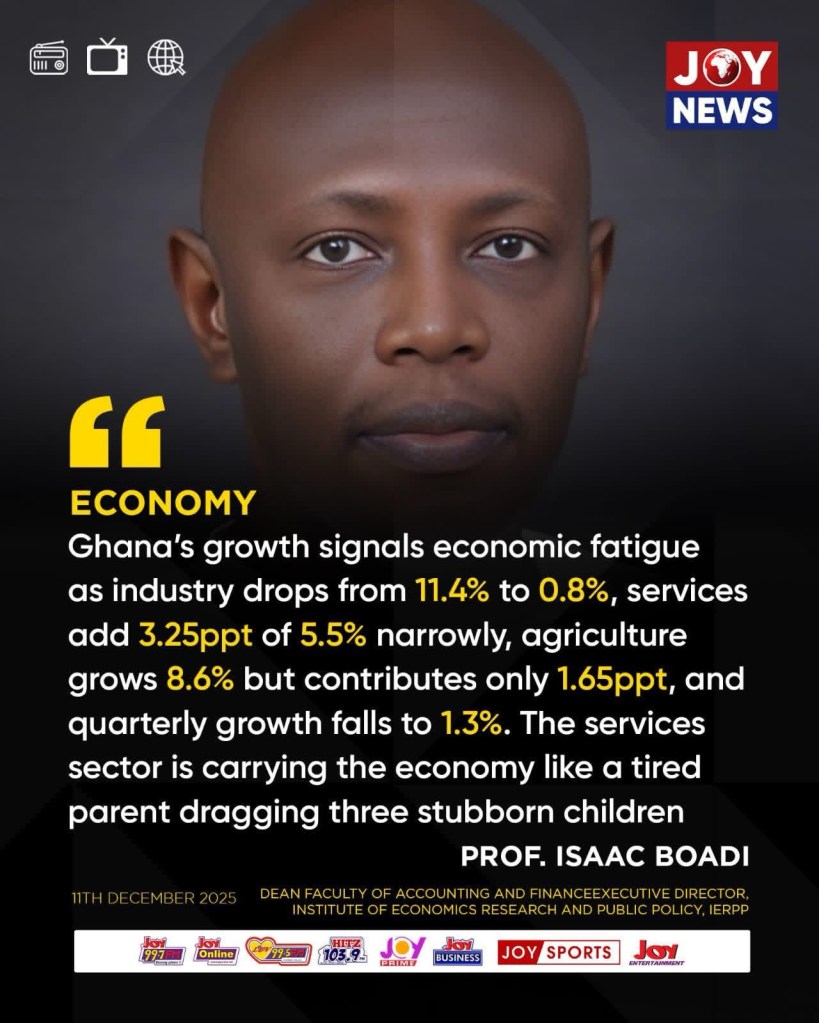
    As a Ghanaian deeply involved in our nation’s economic journey, I read Professor Isaac Boadi’s recent comments on our third-quarter GDP figures with great interest. While I respect his academic rigor, his characterization of our economy suffering from “fatigue” and being like a “tired parent dragging three stubborn children” misses the mark. It misreads a moment of active, intentional change for one of exhaustion.

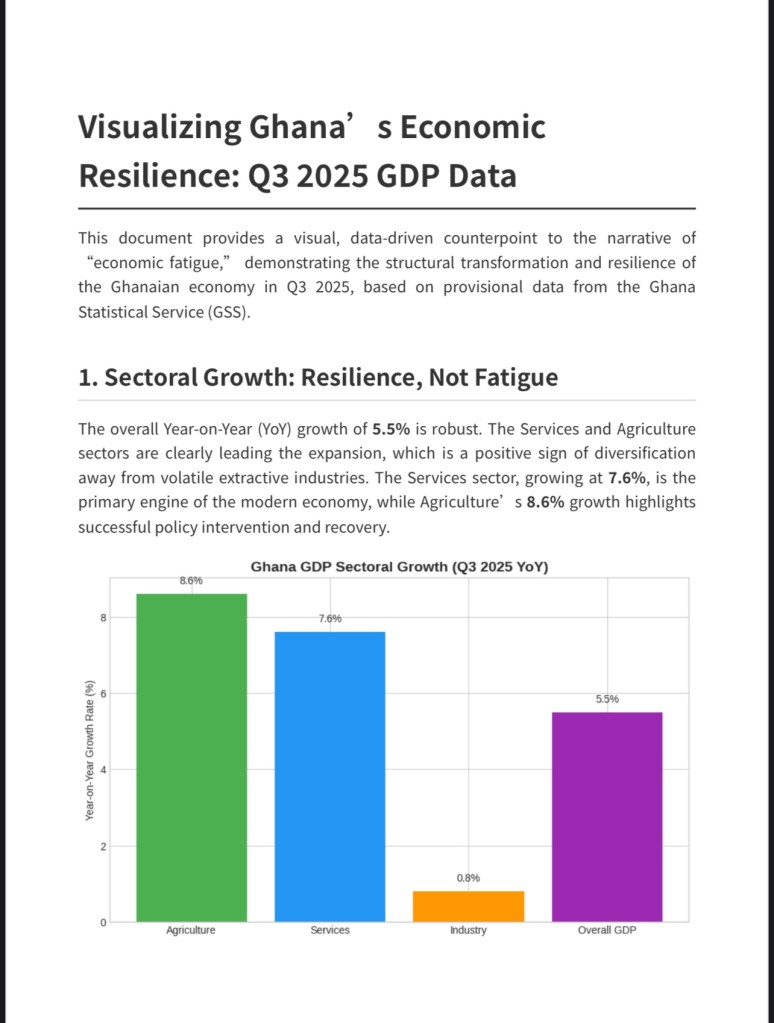
    Let’s start with the basic fact our Ghana Statistical Service confirmed: our economy grew by a solid 5.5% this past quarter compared to the same time last year. That’s a strong sign of sustained momentum. The real story, however, isn’t just in that top-line number. It’s in the powerful details that show where our growth is now coming from.

    Professor Boadi focused on the different growth rates across our three main sectors. But what he sees as a weakness, I see as the very evidence of a necessary shift. For too long, our fortunes rose and fell with global commodity prices. What these new numbers tell me is that we are consciously building a more resilient, modern, and self-sufficient economy.

    Look at our Services sector, which grew by 7.6% and contributed nearly 60% of all growth. This isn’t a tired parent; it’s our vibrant, youthful engine of the future. The standout was Information and Communication Technology (ICT), which exploded by 17%. This is the digital Ghana we are building, creating jobs and innovation that insulate us from external shocks.

    You see services growing at an outstanding 7.6% contributing 60% of all growth

    Then, consider our Agriculture sector. Its growth of 8.6%, a dramatic turnaround from last year is a testament to targeted programs and hard work by our farmers and fishers. The Fishing sub sector alone grew by over 23%. This growth is about national food security, stable prices in our markets, and recognizing the foundational role of agriculture in our development. To downplay this success is to overlook the backbone of our nation.

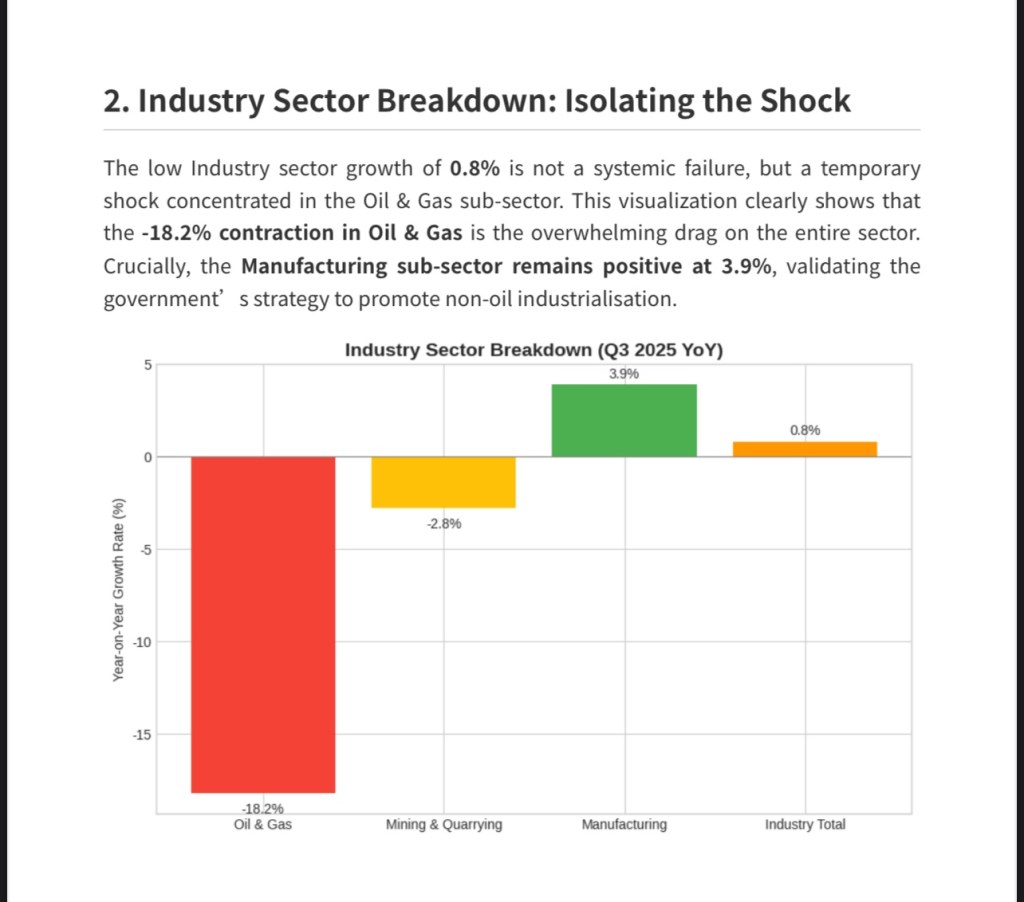
    Though Oil and Gas shows a contraction of -18.2%, Manufacturing that sustains us remains positive at 3.9%

    Yes, the Industry sector slowed, and this is where the professor’s critique seems loudest. But a deeper look is crucial. The slowdown is almost entirely due to a sharp, temporary contraction in Oil and Gas. Crucially, the Manufacturing sub sector: the part that adds real value here at home, remained resilient with 3.9% growth. This distinction is everything. Our policy is to build an industrial base that isn’t hostage to oil prices, and the strength of manufacturing shows we are on that path.

    So, no, I don’t see a tired parent. I see an economy in the midst of a deliberate transformation. The strong, broad-based growth in non oil sectors like Services and Agriculture isn’t about CARRYING a burden; it’s about leading us toward a more balanced and sustainable future.

    We are not denying the challenges in specific areas like oil, but we are clear eyed about the bigger picture. The momentum is with our diversification. That is the story these numbers tell, and it’s a story of deliberate progress, not fatigue. Our focus remains on strengthening this positive trajectory for the prosperity of every Ghanaian.

    THE RESET AGENDA IS TAKING SHAPE 

    • WordPress
    No comments on The Ghanaian Economy Isn’t a Tired Parent. It’s Transforming.
Previous Page
1 2 3 4 … 13
Next Page

Blog at WordPress.com.

Lord Fiifi Quayle

Power. Dignity. Africa. Essays and articles by Lord Fiifi Quayle on politics, economy, and the African condition.

  • About
  • Pictures
 

Loading Comments...
 

    • Subscribe Subscribed
      • Lord Fiifi Quayle
      • Already have a WordPress.com account? Log in now.
      • Lord Fiifi Quayle
      • Subscribe Subscribed
      • Sign up
      • Log in
      • Report this content
      • View site in Reader
      • Manage subscriptions
      • Collapse this bar