By Lord Fiifi Quayle
Ghana’s sovereign spreads are often explained as the inevitable price of fiscal indiscipline, weak institutions, or external vulnerability. This is too convenient and analytically incomplete.
Ghana is not persistently mispriced because it is uniquely risky. It is mispriced because the models used to value its sovereign debt risk are structurally incapable of capturing how its economy actually behaves. The consequence is measurable: a persistent credibility premium embedded in Ghana Eurobond spreads, visible in the sharp overshooting of spreads during crises and the slow, reluctant compression during periods of reform.
The Cost of Model Error: What Ghana’s Empirical Record Reveals
Consider the empirical record of Ghana’s debt restructuring and sovereign risk journey. Ghana entered an IMF-supported programme in 2023 the Ghana IMF programme 2023 after a debt restructuring that imposed losses on domestic and external creditors. This was not an isolated shock. Inflation peaked above 50 per cent in 2022 before declining materially under policy tightening. The cedi experienced repeated episodes of sharp depreciation followed by partial stabilisation. Growth, while volatile, did not collapse in proportion to the scale of financial repricing.
These are not the dynamics of a linear, continuously evolving system. They are the signature of an economy that moves between regimes and is periodically hit by discrete shocks precisely the kind of behaviour that standard frontier market credit risk models are not built to handle.
Yet most sovereign pricing frameworks whether ratings-based approaches, reduced-form spread models, or standard continuous-time stochastic processes, assume a single distribution of outcomes with constant or smoothly varying volatility. In such models, crises appear as extreme deviations rather than expected events. As a result, emerging market sovereign pricing systematically underestimates risk before shocks and overprices it after them.
A More Accurate Framework for Ghana Sovereign Risk Modelling
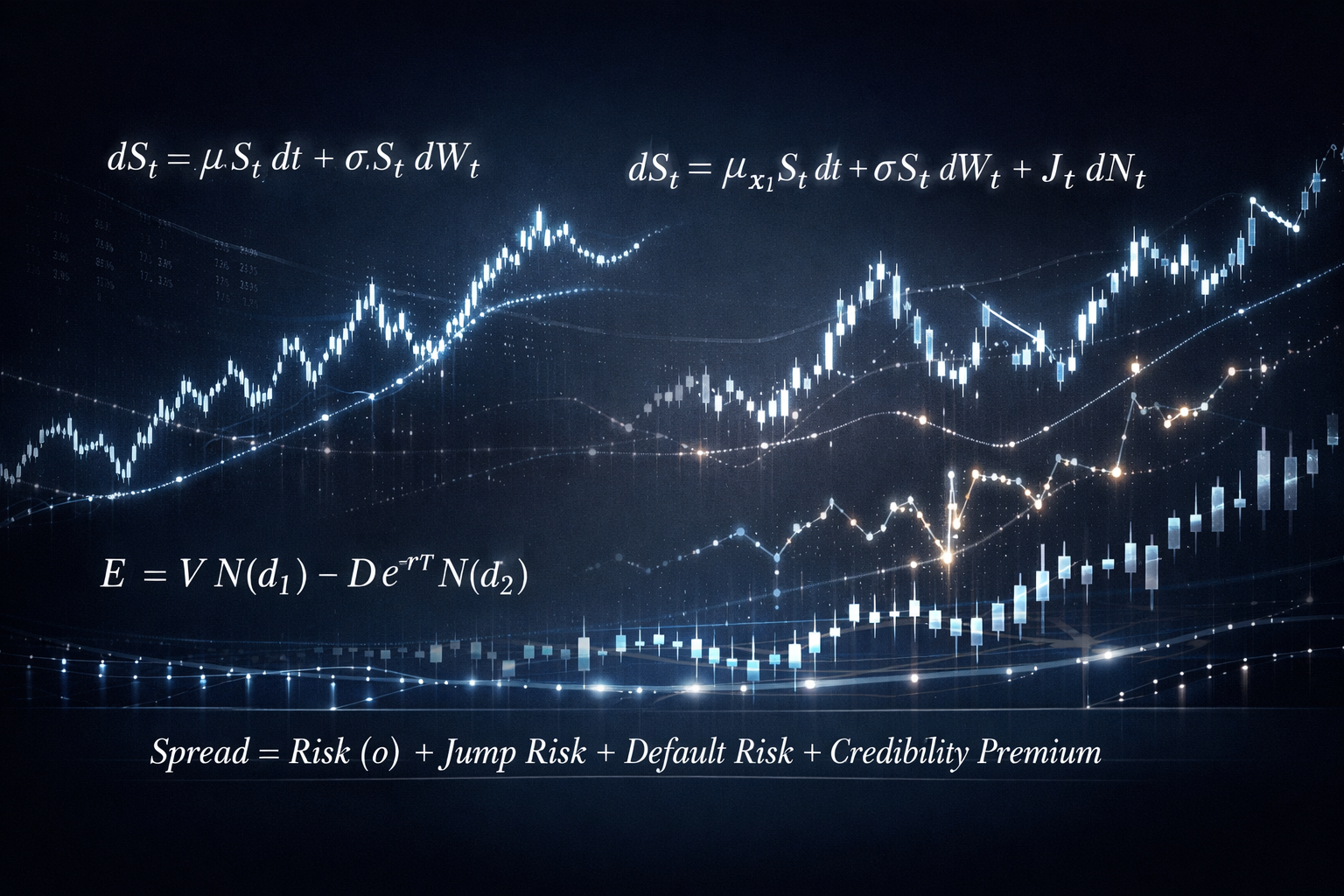
A more accurate approach is available. Ghana’s uncertainty should be priced using a regime-switching jump diffusion model, updated through Bayesian learning and anchored by a structural credit framework. This is not theoretical novelty it is institutional necessity.
1. Regime-Switching: Mapping Ghana’s Macroeconomic States
Regime-switching is essential. Empirical work including IMF country analyses underpinning the Ghana debt sustainability analysis repeatedly identifies distinct macroeconomic states in frontier economies: periods of consolidation, expansion, and distress, each with different inflation dynamics, exchange rate behaviour, and fiscal outcomes. Treating these as a single process produces averages that mislead investors. Separating them allows spreads to reflect the probability-weighted reality of each regime.
2. Jump Diffusion: Pricing Ghana’s Recurring Discontinuities
Jump diffusion is not optional it is necessary. Ghana sovereign debt restructuring events, sudden stops in capital flows, and commodity price shocks are not statistical anomalies; they are recurring features of the frontier market landscape. Modelling them as discrete jumps with estimable probabilities transforms the pricing of Ghana Eurobond spreads. Markets begin to anticipate discontinuities rather than react to them, reducing the amplitude of post-shock repricing.
3. Bayesian Updating: Formalising How Credibility Builds
Investor behaviour must be modelled explicitly. Evidence from IMF surveillance and market data shows that sovereign spreads in emerging and frontier markets adjust sluggishly to improving fundamentals but react abruptly to negative news. This asymmetry reflects imperfect learning. A Bayesian updating framework formalises how beliefs evolve, allowing credibility to build cumulatively as policy consistency is observed rather than being perpetually discounted despite genuine fiscal consolidation.
4. Structural Credit Overlay: Grounding the Model in Ghana’s Balance Sheet
Finally, these statistical features must be tied to economic reality. A structural credit overlay, grounded in Ghana’s debt sustainability analysis, fiscal trajectories, and external financing needs ensures that regimes and jumps are not abstract states but outcomes linked to Ghana’s actual balance sheet constraints.
The Concrete Implications for Ghana’s Borrowing Costs
The implications of correcting Ghana’s sovereign risk model are concrete and measurable.
Sovereign spread compression becomes conditional rather than static distinguishing between temporary stress and structural deterioration in Ghana’s fiscal position.
Shock events are partially pre-priced, reducing the violent dislocations that currently define Ghana’s market access and penalise the cost of Ghana’s Eurobond issuances.
Credible policy improvements translate more quickly into lower borrowing costs, narrowing the gap between reform and reward, the central challenge of why Ghana’s borrowing costs remain high despite real progress.
The African sovereign bond market begins to reflect fundamentals rather than fears, attracting a more stable and informed investor base.
A Call for Institutional Correction, Not Theoretical Refinement
This is not a call for theoretical refinement. It is a call for institutional correction.
Multilateral frameworks, credit rating methodologies, and investor models continue to rely on tools that were not designed for economies characterised by regime shifts and discontinuities. Until that changes, countries like Ghana will continue to pay for model error as much as for genuine economic risk. The question of how IMF models underestimate African risk is not academic it has direct implications for the sovereign spread compression that makes reform financially rewarding.
Markets claim to price reality. But pricing is only as good as the model that underpins it.
Ghana’s problem is not that it is unknowable. It is that it is being measured with the wrong instruments and charged accordingly.
The model required to correct this now exists. Persisting without it is no longer defensible.
GHANA MUST WORK AGAIN
Lord Fiifi Quayle writes on African macroeconomics, sovereign risk, and the political economy of Ghana.
Follow his analysis at lordfiifiquayle.com and on LinkedIn and X @LordFQuayle.
If this analysis shaped your thinking, share it with a policymaker, investor, or economist who needs to read it.
https://lordfiifiquayle.com/2026/03/31/african-uncertainty-premium-financial-markets/
Read Pricing Uncertainty here:https://www.amazon.com/Pricing-Uncertainty-Black-Scholes-African-Finance-ebook/dp/B0GTK7WR12
Leave a Reply