By Lord Fiifi Quayle
“The President’s Strategic delegation to the UNGA signals a serious push for foreign capital, but Ghana’s fundamentals must do the talking.”
As world leaders converge on New York for the annual pageant of diplomacy and dealmaking that is the United Nations General Assembly (UNGA), the composition of a national delegation often speaks volumes. The contingent accompanying Ghana’s President, John Dramani Mahama, is notably strategic and well composed. It is less of a diplomatic mission and more of an economic task force, explicitly designed to sell Ghana as the number one investment destination in a shaky region.
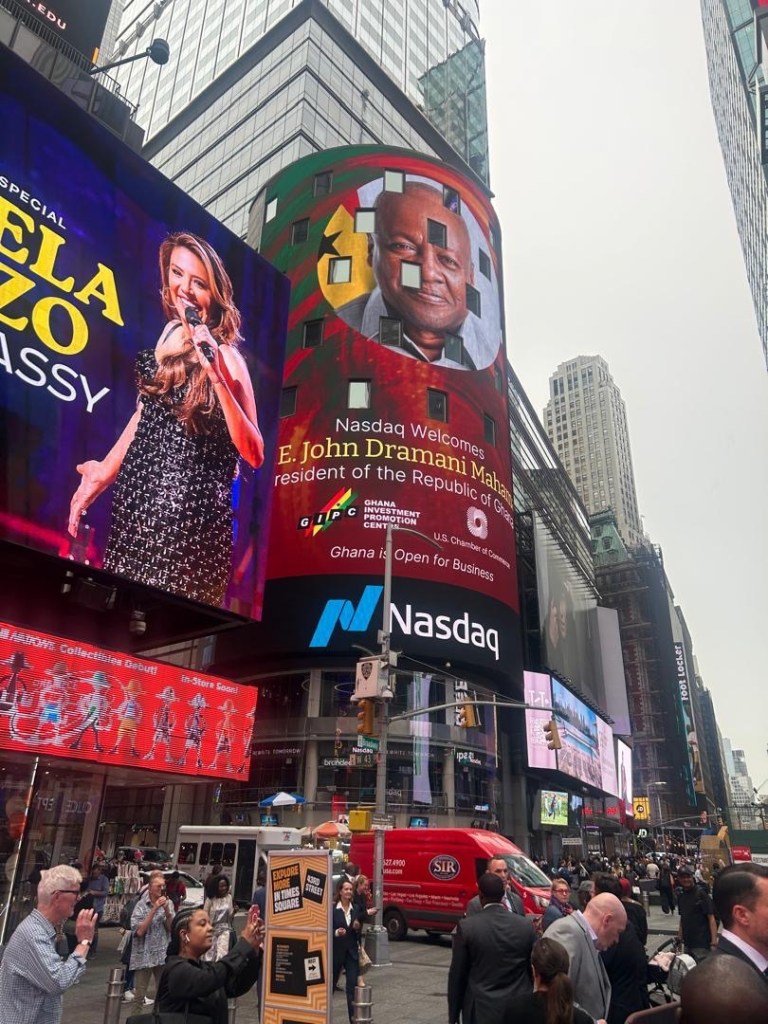
The delegation includes not only the requisite foreign minister but also the ministers of trade and health, the chief executive of the Ghana Investment Promotion Centre, and the President’s closest aides, including his chief of staff and spokesperson. This is not business as usual; it is a strategic deployment. The centrepiece of this effort will be President’s ringing of the NASDAQ closing bell: a clear signal that WE ARE OPEN TO DO BUSINESS with international investors.
This aggressive courtship is born of necessity. Ghana, long hailed as a beacon of stability and democracy in West Africa, has faced a brutal economic reckoning. Soaring inflation, a precipitous currency depreciation, and unsustainable debt levels forced the government into a $3bn bailout programme with the International Monetary Fund (IMF) in 2023. While the programme has provided a lifeline, restoring macroeconomic stability is a painful and incomplete process. The real, long-term solution lies in catalysing sustainable, private sector led growth. Hence, President Mahama’s mission to New York.
The strategy has a recent precedent. Visits to Japan and Singapore reportedly yielded significant investment pledges. The UNGA offers a far more concentrated arena to replicate that success, providing unmatched access to Fortune 500 CEOs, the heads of sovereign wealth funds, and other leaders with the capital to transform Ghana’s economic prospects. The focus is likely to be on sectors where Ghana holds comparative advantage: agro-processing, light manufacturing, technology services, and, crucially, the downstream value addition in its natural resources, from gold to lithium.
However, as any seasoned investor will note, the sizzle of a NASDAQ bell-ringing is meaningless without a credible steak. A strategic delegation signals intent, but it also incurs significant cost—a fact not lost on a Ghanaian public grappling with the austerity measures of an IMF programme. The government will be keenly aware that the optics of such a trip demand TANGIBLE returns.
The true test is not whether Mr. Mahama can secure handshakes and memorandums of understanding, but whether he can assure investors that Ghana is fixing the foundational issues that often deter capital. Investors will be asking tough questions: Is the judiciary truly independent and capable of enforcing contracts? Is the energy sector reliable and affordable? Is the bureaucracy streamlined and resistant to the corruption that still plagues many emerging markets? Most importantly, will the fiscal discipline demanded by the IMF hold after the next election?
Ghana’s democratic credentials and its role as a regional security anchor are powerful assets. But in the global competition for capital, stability is the baseline. The winning differentiators are transparency, efficiency, and profitability.
President Mahama and his high powered delegation are undoubtedly right to pitch Ghana’s story with vigour. The country’s potential is immense. But the most convincing arguments they can make in those New York meeting rooms are not about hope, but about evidence: evidence of a judiciary that works, of regulations that are fair, and of a government committed to being a partner, not a barrier to enterprise. If this delegation can secure investments that create jobs and diversify the economy, the cost of the trip will be forgotten. If not, it will be seen as just a waste of taxpayer’s money.
The hope for Mother Ghana rests not on the delegation’s size, but on the substance of the change it promises to deliver.
GHANA MUST WORK AGAIN
 Lord Fiifi Quayle
Leave a comment