By Lord Fiifi Quayle
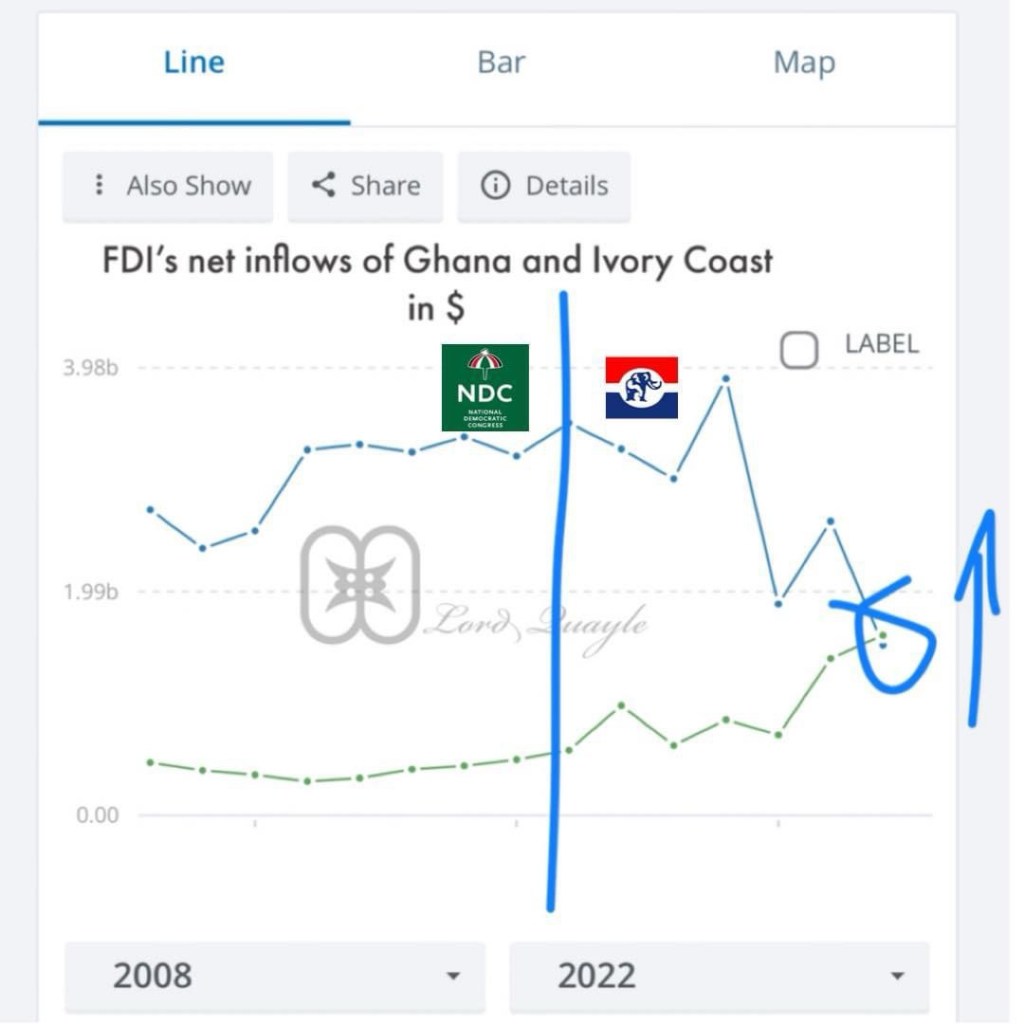
Ghana is regarded as a beacon of hope in West Africa, particularly in terms of foreign direct investment (FDI). From 2008 to 2016, the country experienced a remarkable surge in FDI, peaking at $3.5 billion in 2016 under the stewardship of the National Democratic Congress (NDC). However, since the New Patriotic Party (NPP) came to power, this positive trajectory has sharply declined, raising major concern about Ghana’s investment environment and economic prospects.
FDI Trends: A Comparative Analysis
Data from the World Bank and the Bank of Ghana reveals a stark contrast between Ghana and its neighbor, Côte D’Ivoire. While Ghana’s FDI inflows have plummeted to $1.1 billion in 2021, Côte d’Ivoire has capitalised on a favourable investment environment, achieving $1.8 billion in FDI inflows in the same year. This brings us to the urgent need for reassessment of our economic policies and governance structures.
Factors Contributing to FDI Decline in Ghana
1. Inconsistent Government Policies: The NPP’s tenure has been marked by a lack of continuity in economic policies, leading to uncertainty among investors. Frequent changes in regulations have created a perception of instability, discouraging long-term investments.
2. Regulatory Uncertainty: Bureaucratic hurdles and a convoluted regulatory framework have further complicated the business landscape. Investors often face delays in obtaining permits and licenses, which can significantly hinder their operations.
3. Corruption and Governance Issues: Corruption remains a significant concern, with reports of graft and mismanagement eroding investor confidence. The perception of a lack of transparency in government dealings has made Ghana a less attractive destination for foreign investors.
4. Infrastructure Deficiencies: Ghana’s infrastructure, particularly in transportation and energy, has not kept pace with its economic ambitions. Inadequate roads, unreliable power supply, and limited access to essential services pose challenges for businesses seeking to operate in the country.
5. Currency Instability: The depreciation of the Ghanaian cedi has further compounded the challenges faced by foreign investors. Currency fluctuations can lead to unpredictable costs and reduced profitability, making the market less appealing.
6. High Tax Burden: The introduction of new taxes and tariffs has added to the financial burden on businesses, prompting some investors to reconsider their commitments to the Ghanaian market.
7. Skilled Labor Shortages: Despite a growing population, Ghana faces a shortage of skilled workers in key sectors. This lack of human capital can deter foreign companies looking to establish operations in the country.
Côte d’Ivoire: A Model for Investment Attraction
In stark contrast, Côte d’Ivoire is successfully implementing policies to create a conducive environment for FDI. The Ivorian government is prioritising infrastructure development, streamlining regulatory processes, and fostering a climate of stability and transparency. These efforts have not only attracted foreign investors but have also facilitated domestic entrepreneurship, resulting in sustained economic growth.
Conclusion
The decline in FDI inflows under the NPP’s governance raises many questions about Ghana’s economic strategy and its ability to compete in an increasingly globalised market. As Côte d’Ivoire continues to attract significant foreign investment, Ghana must urgently address its internal challenges to restore investor confidence. Failure to do so may result in a further erosion of its economic standing in the region, jeopardising its potential for growth and development. The time for introspection and reform is now, as Ghana must reclaim its status as a leading investment destination in West Africa.

 Lord Fiifi Quayle
Leave a comment